Translate

Wednesday, January 20, 2016

Original Production Animation Cel of Prince Charming From "Cinderella," 1950


Original hand inked and hand painted production cel of Prince Charming set on a lithographic background from "Cinderella," 1950; Size - Prince Charming: 6 1/4 x 3 1/4", Image 7 1/2 x 7"; Unframed.

The 1950 Walt Disney feature film "Cinderella" was based on the French version of the tale by Charles Perrault, entitled "Cinderella" and written in 1698. The film was the second in the series of great Princess films developed by Disney, the first being Snow White in 1937. The character of Cinderella is usually front and center in the pantheon of Disney Princess merchandise, perhaps because she is the only Princess not to be of a noble blood line who ended up marrying a Prince and becoming royalty.

According to Christopher Finch, from his book "The Art of Walt Disney":
"Disney insisted that all scenes involving human characters should be shot first in live-action to determine that they would work before the expensive business of animation was permitted to start. The animators did not like this way of working, feeling it detracted from their ability to create character. The animators understood the necessity for this approach and in retrospect acknowledged that Disney had handled things with considerable subtlety."

Prince Charming was animated by Eric Larson, who according to Andreas Deja "Confessed to some of us newcomers that he felt kind of embarrassed about the stiffness in his performance." The Prince was voiced by William Phipps, and after Phipps's initial audition; the studio was so impressed with his performance that Walt Disney himself offered him the role. William Phipps is perhaps best known for his roles in dozens of classic sci-fi and westerns, both in films and on television. It is a little known fact that Mike Douglas (yes of "The Mike Douglas Show") provided the singing voice for Prince Charming for the song "So This Is Love,"as the Prince and Cinderella danced together at the Grand Ball.


Original production animation cel of Prince Charming without the background.

A bit of trivia, not only is the name of the Prince never revealed, he is never actually referred to as "Prince Charming" in "Cinderella." His name was mentioned only in merchandise and, more recently in the various films and TV appearances of the character. Prince Charming was the first Disney Prince to participate in a duet with his respective love interest, the first Prince to be featured in a wedding celebration, and the first to  dance with his heroine just after they met.

This is an extremely rare original production animation cel of Prince Charming from "Cinderella." He is eyes open, wearing his classic yellow green coat with gold epaulets and his gold striped red pants. Production artwork is rare for "Cinderella" and, because Prince Charming was only in the film for a relatively short time, original animations cels and drawings are very difficult to acquire.

Original Production Animation Cel of Lady From "Lady and the Tramp," 1955


Original hand inked and hand painted production cel of Lady set on a lithographic copy of a production background from "Lady and the Tramp," 1955; Size - Lady: 4 1/4 x 4 3/4", Image 5 1/2 x 7 1/2", Mat 12 1/4 x 13"; Double matted with a brass plaque insert.

“Oh, I love her. What a perfectly beautiful little Lady.” ―Darling

"Lady and the Tramp" (released on June 22, 1955) is a full length featured animated film produced by Walt Disney and released by Buena Vista Distribution. The film was the 15th in the Walt Disney Animated Classics series, and it was the first animated feature filmed in with the CinemaScope widescreen film process. The film was based on the story "Happy Dan, The Whistling Dog" by Ward Greene and tells the story of a female American Cocker Spaniel named Lady who lives with a refined, upper-middle-class family. Lady meets a male stray mutt named Tramp and they embark on many exciting and romantic adventures.


Original Production cel of Lady without the background.

One evening in 1937, Disney storyman Joe Grant invited Walt Disney over to his house for dinner and ended up showed Disney a drawing he had made of his pet spinger spaniel, who was named Lady. Walt loved the drawing and suggested that Joe make a storyboard out of it; which he did and the plan was to create a new animated film, simply titled "Lady." The story that was pitched ended up being too simplistic to Walt Disney's taste, and the project was put on hold until about 20 years later.

Lady was wonderfully animated by the great Disney artist Ollie Johnston and she was voiced by Barbara Luddy. Barbara Luddy (1908 — 1979) was an American actress from Great Falls, Montana and she starred in silent pictures in the 1920s. She was also a prolific radio performer; known for her performances on the long running radio show "The First Nighter Program" which aired from 1936 until 1953.


Matted production animation cel of Lady with inset brass title plague.

However, Luddy is perhaps best remembered for her voice work in Walt Disney animated films; with her most memorable role being that of Lady from Lady and the Tramp.  She also performed in Sleeping Beauty (voice of Merryweather), One Hundred and One Dalmatians (voice of Rover), Robin Hood (voice of both Mother Church Mouse and the Mother Rabbit), and the Winnie-the-Pooh featurettes (Winnie the Pooh and the Honey Tree, Winnie the Pooh and the Blustery Day, and Winnie the Pooh and Tigger Too) all of which she provided the voice for Kanga.

This is a large and wonderful original production animation cel of Lady standing with her eyes and mouth open. A great addition for any collection.

Sunday, January 17, 2016

Original Production Animation Drawing of Cruella De Vil From "101 Dalmatians," 1961


Original production drawing in red, blue, and graphite pencils of Cruella De Vil from "101 Dalmatians," 1961; Numbered 32B lower right and upper center; Size - Cruella 6 x 4", Sheet 12 1/2 x 15 1/2"; Unframed.

To purchase this drawing or to visit the Art Gallery, CLICK HERE

"We'll find the little mongrels if it takes till next Christmas. Now get going! And watch your driving, you imbeciles! Do you wanna get nabbed by the police?" - Cruella De Vil

"One Hundred and One Dalmatians" ("101 Dalmatians"), is a 1961 full length animated feature film by Walt Disney Productions. It was adapted from Dodie Smith's 1956 novel of the same name. It stars Rod Taylor as the voice of Pongo and Cate Bauer as the voice of Perdita; with Betty Lou Gerson as the voice of the evil and villainous Cruella de Vil. The animation of all the characters from the film was quite extraordinary. Pongo, who had a total of 72 different spots, was animated by the famed Disney artist Ollie Johnston.

In the case of some Disney characters, drawings are more rare than the cels; for example Shere Khan from "The Jungle Book," Prince John from "Robin Hood," and Cruella de Vil from "101 Dalmatians." Cruella along with Maleficent are two of the most favorite of all the Disney villains, and they were both animated by Marc Davis. The character was created by Dodie Smith for his novel "101 Dalmatians" in 1956, but it was Davis's visual interpretation that the world remembers. Although some of Cruella's traits were based in the novel, Davis along with Bill Peat, morphed the character by making her razor thin and exaggerating her oversized coat onto her thin frame. The long cigarette holder was modeled on one Davis used himself. Inspiration was also drawn from Hollywood legends Tallulah Bankhead, Bette Davis, and Rosalind Russell. Movement, according to Davis, was consistent "like someone you wouldn't like," and another inspiration was based on "one woman I knew who was just a monster. She was tall and thin and talked constantly - you never knew what she was saying, but you couldn't get a word in edgewise."


Close up of the Cruella De Vil original production animation drawing.

The voice of Cruella was provided by Betty Lou Gerson. She had worked for Disney prior as the narrator for Cinderella, but her voice talent as Cruella De Vil is her tour de force! The highly pitched phrase "Anita Darling!" is completely iconic and has become part of Disney pop culture.

The following three paragraphs about the animation of Cruella's car is from Disney Wiki:
"Back in the '60s, Disney animators were using Xerox camera technology to translate pencil drawings on paper into line work on cels, which replaced the beautiful, traditional hand-painted cels in order to save money on creating animated films. During the production of One Hundred and One Dalmatians, the studio came up with an idea on how to animate Cruella's Car, the animators built an actual white model of her car out of cardboard with bold black lines on the edges."

"To make the wheels articulate, the animators took a long piece of cloth, taped little pieces of wooden dowling underneath it and then put the car on top of the cloth suspended from a kite string, and then they would pull this long piece of fabric with all these pieces of wooden dowling underneath the wheels and they would shoot a take of that. To give it the look that the car had suspension they put in springs so it would have this little bouncy effect. The footage would then be run through the same Xerox process that was being used to transfer pencil line work onto cels and then painted to what was seen in the final film. When Cruella is seen driving her car up the hill of snow, a sand-like substance was used for it to drive through and shot it all in slow motion."

"The process of shooting models with those black outlines worked very successful when making One Hundred and One Dalmatians and it was a clever idea to save money. The current status of the original model of Cruella's car remains in storage, mostly fully intact."

This is a very rare original production drawing of Cruella De Vil. She is eyes and mouth open, driving her car (that is registered as "DEV IL"), and looking for the dalmatian puppies that had escaped from being held prisoner by her henchmen Horace and Jasper. You can see the registered outline of the door to the car as well as a small part of the steering wheel.

Original Production Animation Cel of The Headless Horseman From "The Legend of Sleepy Hollow" Section of "The Adventures of Ichabod and Mr. Toad," 1949


Original hand-painted and hand inked production cel of the Headless Horseman set on a lithographic background from "The Legend of Sleepy Hollow" section of "The Adventures of Ichabod and Mr. Toad," 1949; Size - Headless Horseman: 4 1/4 x 4 1/2", Image 7 x 5 3/4"; Unframed.
"Yaaaah-ha-ha-ha-ha-haaaa!" - The Headless Horseman

"The Adventures of Ichabod and Mr. Toad," 1949 is an animated package film produced by Walt Disney Productions and released by RKO Radio Pictures. The film consists of two segments – the first is based on the 1908 children's novel "The Wind in the Willows" by British author Kenneth Grahame, and the second is based on the 1820 short story "The Legend of Sleepy Hollow," (named Ichabod Crane in the Disney film) by American author Washington Irving. The famed American singer and actor Bing Crosby provided the voice of Ichabod Crane, Brom Bones, and the Narrator.

The story takes place in October 1790 when Ichabod Crane, a lanky, gluttonous, superstitious yet charming man; arrives in Sleepy Hollow, New York. It's a small village north of Tarrytown and is renowned for its ghostly hauntings and Ichabod is to be the town's new schoolmaster. Despite his odd behavior and awkward appearance, he soon wins the hearts of the village's women. Brom Bones, the roughish town hero, does his best to bully Ichabod; however he is very good at ignoring Brom's taunts. Soon Ichabod falls in love with eighteen-year-old Katrina van Tassel, the beautiful daughter and only child of Baltus van Tassel who is the richest man in all of Sleepy Hollow. Brom, who is also in love with the beautiful Katrina, begins to compete with the schoolmaster for her affection. However, Ichabod succeeds in winning Katrina over at every opportunity. Unbeknownst to Ichabod, Katrina is only using him to make Brom jealous.

Both Brom and Ichabod are invited to the annual van Tassel Halloween party. While sitting down to dinner, Brom tells Ichabod and the party guests the ghost story of the Headless Horseman, who had lost his head a long time ago during the Revolutionary War. Ever since, on every Halloween night he rides into Sleepy Hollow looking for a new head. The only way to escape him is to cross the covered bridge, as the Headless Horseman's evil powers are limited to within the dark woods.

After the Halloween party ends, Ichabod rides home alone and keeps imagining that he is being followed. He hears strange sounds and then realizes that it's only cattails bumping against a log; Ichabod and his horse begin to hysterically laugh. But then suddenly both stop, as they realize that another laugh has joined them. As Ichabod and his horse slowly turn around, they find the Headless Horseman about to attack them with his sword. The Horseman begins to chase them, laughing all the while. Ichabod gallops for the bridge and barely manages to make it across. As Ichabod turns around, he screams as the Horseman's black horse rears up, and the Headless Horseman throws a flaming jack o' lantern right at him. The very next morning, Ichabod's hat was found next to a shattered pumpkin; however, Ichabod was never heard from again.


Original production animation cel of The Headless Horseman without the background.

The Headless Horseman was animated by veteran Walt Disney animator Wolfgang Reitherman. During an Academy Award tribute to Reitherman's work in the early 1980's, his wonderful chase sequence that occurs between Ichabod Crane and the Headless Horseman was screened. Afterwards he turned to the audience and said, "You know, this stuff is holding up pretty good after all these years."

The Headless Horseman is actually one of a very few Disney Villains to actually "win" rather than being defeated at the end of the film. Also, despite having a small amount of screen time, the Horseman is considered one of the darkest and most disturbing of all the Disney Villains. This is an extremely rare original production animation cel of the Headless Horseman. He is full figure with his burgundy cape blowing in the wind, as he wields a large sword in his left hand. He is astride his dark black horse whose eyes are glowing red, and both are charging forward to pursue Ichabod Crane.

Saturday, January 9, 2016

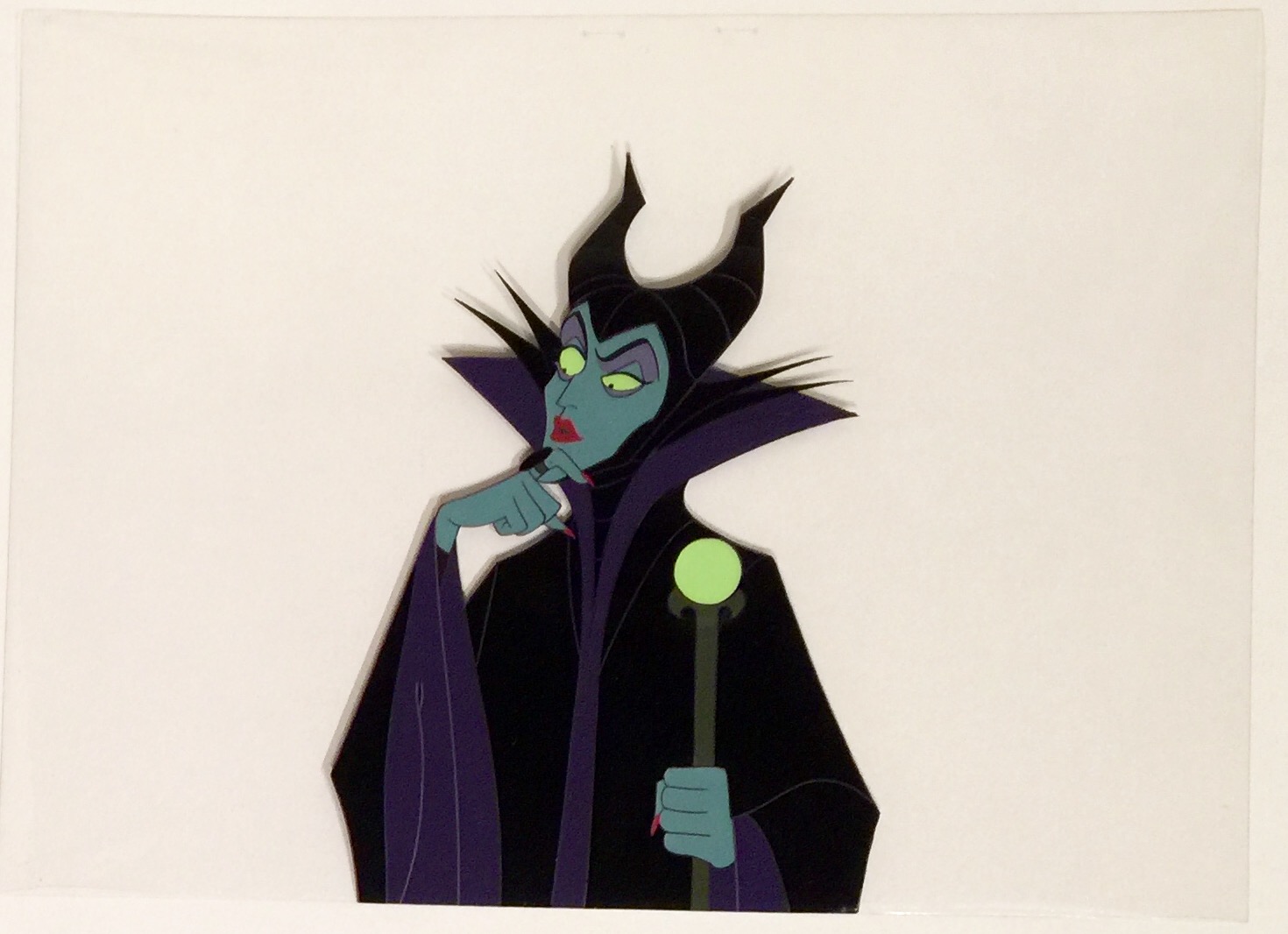
Original Production Animation Cel of Maleficent From "Sleeping Beauty," 1959


Original hand painted and hand inked production cel of Maleficent set on a lithographic background from "Sleeping Beauty," 1959; Size - Maleficent 6" x 4 1/2", Image 7 1/4 x 10"; Unframed.


"Are you sure you searched everywhere?" - Maleficent

If you ask people to name their favorite Disney Villain, chances are you will one of three answers; The Evil Queen/Witch from "Snow White and the Seven Dwarfs," Cruella DeVil from "101 Dalmatians," or Maleficent from "Sleeping Beauty." Two of the three, Cruella and Maleficent, were created/drawn by the great animator Marc Davis. Davis was part of what has been dubbed Disney's Nine Old Men; the core group of animators, some becoming directors, that created the finest animated films ranging from "Snow White and the Seven Dwarfs", 1937 to "The Rescuers", 1977.

The voice of Maleficent was performed by Eleanor Audley. She had worked for Disney prior by also being the voice for the cold and calculating Lady Tremaine (The Stepmother) in "Cinderella." If is known that Frank Thomas for Lady Tremaine and Marc Davis for Maleficent, incorporated facials features of Eleanor into both characters.


Original production cel of Maleficent without the background.

This wonderful cel of Maleficent is from the scene in Maleficent's Castle when she is furious over the fact that her Goons (after 16 years) have not been able to find Princess Aurora. Maleficent screams, "It's incredible! 16 years, and not a trace of her! She couldn't have vanished into thin air! Are you sure you searched everywhere?" The pose is just perfect, with both eyes open and her right eye wider than the left. Her finger is resting on her chin as she ponders whether her Goons are being truthful about the fact that they searched everywhere. She is grasping her staff with her left hand and you can see her large ring on the index finger of her right hand. A rare and impressive pose from one of the greatest Disney Villains of all time!

Original Production Animation Cel of The Walrus and The Carpenter From "Alice In Wonderland," 1951


Original hand inked and hand painted production cel of The Walrus and The Carpenter set on a lithographic background from "Alice In Wonderland," 1951; Size - Walrus: 6 1/4 x 5", Carpenter: 4 1/2" x 3", Image 8" x 9"; Unframed.

To purchase this cel or to visit the Art Gallery, CLICK HERE

"Alice's Adventures in Wonderland" (commonly shortened to "Alice in Wonderland"), is a 1865 novel written by English author Charles Lutwidge Dodgson who wrote under the pseudonym Lewis Carroll. Disney reworked the story to fit with both a younger audience and a time frame suitable for an animated film (it's run time is only 75 minutes). 

One of the most memorable segments of "Alice In Wonderland" were the two characters The Walrus and The Carpenter. Both of them were voiced by J. Pat O'Malley and they were animated by John Lounsbery, Ward Kimball, Wolfgang Reitherman, and Charles A. Nichols. They were originally created by Lewis Carroll for his book "Through the Looking Glass."

J. Pat O'Malley had a long history with voice work for Disney: he was the Cockney guy in the "Supercalifragilisticexpialidocious" sequence in "Mary Poppins," 1964, Cyril Proudbottom, Winkie, and a policeman in "The Adventures of Ichabod and Mr. Toad," 1949, and Colonel Hathi and Buzzie in "The Jungle Book," 1967. O'Malley performs all the character voices in the "The Walrus and the Carpenter" segment (besides Alice), including Tweedledum and Tweedledee, The Walrus, The Carpenter, and Mother Oyster.

The Walrus and The Carpenter are two hobos whose story was told to Alice by Tweedle Dee and Tweedle Dum. The Walrus acts as the leader of the duo and in many ways he is like Honest John from "Pinocchio." They are both conniving moochers who will resort to trickery to get what they want. Finding a job and working is the last thing on The Walrus's mind, regardless of his constant ramblings of "cabbages and kings" (his way of saying that his future will soon be bright). He is also very greedy and tricks The Carpenter into leave the room so that he can eat all of the naive oysters (whom he had convinced to follow him ashore and into a restaurant that The Carpenter built out of left over remnants from a boat).


Original production cel of The Walrus and The Carpenter without the background.

This is a wonderful original production cel of both The Walrus and The Carpenter. Both are full figure, with The Walrus carrying his walking stick and The Carpenter carrying his hammer.

Original Production Animation Cels of Prince Phillip and Diablo from "Sleeping Beauty," 1959


Original hand painted and hand inked production cels of Prince Phillip and Diablo set on a lithographic background from "Sleeping Beauty," 1959; Size - Prince Phillip: 6 1/2 x 6 1/2", Diablo 2 1/4 x 2", Image 10 1/4 x 22"; Unframed.

Prince Phillip was animated by Milt Kahl and voiced Bill Shirley and Aurora was animated by Marc Davis (who was also lead animator for Maleficent) and voiced by Mary Costa. Both Bill and Mary would be live action models for Prince Phillip and Briar Rose/Princess Aurora for the animators, and their chemistry was magical on screen. In addition, their singing together was one of the many highlights of the film.


Close up of the original production cel of Prince Phillip.

As discussed by Walt Disney animator Andreas Deja, Milt Kahl did not like the job of animating Prince Phillip:
"Some of you might know that Milt absolutely despised working on the prince. During one of our get togethers I asked him, how he could do such a beautiful job on a character he loathes. To my best recollection he said: 'Well, the character needs to be in the picture, I didn't like the assignment, but you do the best you can.'"

The animation of Prince Phillip by Milt Kahl was radically different than prior Princes in other films.  Phillip was an active character; speaking to his horse Sampson and Sampson understanding what he was saying.  Phillip was also seen as a child at the start of the film, had to be animated in more than one outfit, was the first Prince to use weapons against a Villain; and had to speak, interact, and sing with his love interest Princess Aurora/Briar Rose.


Close up of the original production cel of Diablo.

The raven Diablo is, without a doubt, Maleficent's only competent henchman. Diablo, the Spanish word for "devil" or "demon," was not actually named in the film itself. He was animated by Disney master animator Marc Davis and Diablo's voice was provided by Dal McKennon.

Dallas Raymond McKennon (July 19, 1919 – July 14, 2009), sometimes credited as Dal McKennon, was an American actor, with extensive work as a voice actor that lasted over 50 years. He worked on many projects for Walt Disney Studios and his voice can be heard in movies such as "Lady and the Tramp," "One Hundred and One Dalmatians," "Mary Poppins," and "Bedknobs and Broomsticks." He also provided the voices for many Disney Attractions such as the famous Big Thunder Mountain Railroad safety spiel, a pair of laughing hyenas in the Africa Room portion of It's A Small World, Benjamin Franklin's voice in Epcot's The American Adventure and the voice of Zeke in the Country Bear Jamboree.

This is a fantastic two cel setup of Prince Phillip and Maleficent's pet raven Diablo. After the Three Fairies, Flora, Fauna, and Merryweather break Prince Phillip out of Maleficent's dungeon, they create and give to him two magical items: the Sword of Truth and the Shield of Virtue. When Diablo realizes that Prince Phillip has escaped, he flies around the castle squawking and alerting Maleficent's Goons. In this fantastic cel setup Prince Phillip is full figure, eyes open, and holding both the Sword of Truth and the Shield of Virtue. Diablo is to the left, his wings outstretched, and he is full figure with his eyes open. A great large pan setup with the overall image being an impressive 10 1/4 x 22 inches long!