Translate

Sunday, January 1, 2017

Original Production Animation Cel of Duchess from "The Aristocats," 1970


Original hand painted production animation cel of Duchess with effects overlay cel from "The Aristocats," 1970; Walt Disney Studios; Set over a hand prepared custom background; With original Art Corner Certificate sticker and custom engraved brass title plaque; Size - Duchess: 6 1/3 x 8 1/2", Image: 9 1/2 x 11 1/2"; Unframed.

To purchase this cel or to visit the Art Gallery, CLICK HERE!

"Boy! Your eyes ARE like sapphires." - Thomas O'Malley speaking to Duchess

"The Aristocats," 1970 is an animated feature film produced and released by Walt Disney Productions.  This was the last film project to be approved by Walt Disney himself, as he died in late 1966, before the film was finally released to theaters by Buena Vista Distribution on December 11, 1970. "The Aristocats" featured the voice talent of Eva Gabor, Hermione Baddeley, Phil Harris, Dean Clark, Sterling Holloway, Scatman Crothers, and Roddy Maude-Roxby. 

The film is based on a story by Tom McGowan and Tom Rowe, and centers around a family of aristocratic cats. After the mistress's butler kidnaps them (to gain his mistress' fortune which was intended to go to the cats) an unlikely alley cat acquaintance helps them escape and be returned to their home.

Duchess is a long-haired purebred white Turkish Angora cat with blue eyes (shining like sapphires) and wearing a gold and jeweled collar that is studded with diamonds. She is the mother of three kittens; Marie, Berlioz, and Toulouse and her owner is the aristocratic Madame Adelaide Bonfamille. Duchess was voiced by Eva Gabor who was a Hungarian-born American socialite and actress. Robie Lester who was an American Grammy-nominated voice artist and singer, provided the singing voice for Duchess.


Close up of the original Art Corner Certificate sticker.

According to veteran Walt Disney animator Andreas Deja:
"Duchess was animated by quite a few artists, I would say that Ollie Johnston did some of the nicest scenes, educating the kittens etc.. Frank Thomas came up with good acting scenes as well, when Duchess meets O'Malley for the first time, and when she says goodbye to him at the end of the movie. Milt Kahl set her basic design based on Ken Anderson's drawings."

Abraham DeLacey Giuseppe Casey Thomas O'Malley (simply known as Thomas O'Malley) the alley cat was also animated by Ollie Johnston and Milt Kahl. O'Malley was marvelously voiced by Phil Harris, who was an American singer, songwriter, jazz musician, actor, and comedian. Harris also worked as a voice actor for two other Walt Disney animated feature films: "The Jungle Book," 1967 as Baloo the Bear and "Robin Hood," 1973 as Little John (another bear).


Custom engraved brass title plaque.

Thomas O'Malley had referred to Duchess's eyes as sapphires earlier in the film, but at that time he was using it merely as a pickup line. Now under the stars, a full moon, on the rooftops of Paris, and just after tucking the kittens into bed; O'Malley stares into Duchess's eyes and says, "Boy! Your eyes ARE like sapphires." It is at this point in the film when O'Mally, the alley cat, falls in love with Duchess. This is an absolutely spectacular original production cel of Duchess from this critical scene in the film. The original star overlay cel is also included, making this a trophy setup from the film.

Original Production Animation Cel of The Indian Chief from "Peter Pan," 1953


Original hand inked and hand painted production animation cel of the Indian Chief from "Peter Pan," 1953; Walt Disney Studios; Set over a hand prepared custom background; With custom engraved brass title plaque; Size - Indian Chief: 6 3/4 x 9", Image 7 1/2 x 10"; Unframed.

To purchase this cel or to visit the Art Gallery, CLICK HERE!

"Now you know why the red man's red!" - The Indian Chief

The author J. M. Barrie first used Peter Pan as a character in a section of the adult novel "The Little White Bird" in 1902. He returned to that character with his stage play entitled "Peter Pan, or The Boy Who Wouldn't Grow Up," which premiered in London on December 27, 1904. The play ran until 1913, and it was later adapted by Walt Disney for the animated feature film entitled, "Peter Pan," in 1953.

The Indian Chief is Tiger Lily's father and the leader of the Indians of Neverland. He was voiced by Candy Candido, who was an American radio performer, bass player, vocalist, and animation voice actor. He is best remembered for his famous line, "I'm feeling mighty low." Candido voiced many characters for Disney including: the Wolf's roars in "Peter and the Wolf," one of Maleficent's goons in "Sleeping Beauty," Shere Khan's roars in "The Jungle Book," the Captain of the Guard in "Robin Hood," Brutus and Nero in "The Rescuers," the deep voiced prisoner in the Haunted Mansion attraction, Fidget the peg-legged bat and a Reprobate in the Pub in "The Great Mouse Detective," and Bear growls (along with Clarence Nash) in "The Fox and the Hound." The Indian Chief was animated by veteran Walt Disney animator Ward Kimball.

From Walt Disney animator Andreas Deja (who animated Jafar):
"The Indian Chief was Kimball's main contribution to the film. What fantastic animation! So inventive (as usual). I remember thinking about this character frequently when animating dialogue scenes with Jafar. It's so much fun to come up with weird mouth shapes, as long as they work with the dialogue reading and the character's personality."


Custom engraved brass title plaque.

In the film when John Darling, Michael Darling, and the Lost Boys are out hunting Indians; they end up being captured by them instead. They are bound and taken to the Native Camp and brought before the Indian Chief. He believes that they have kidnapped his daughter Tiger Lily (who was actually kidnapped by Captain Hook and Mr. Smee), and he orders that they be burned at the stake if Tiger Lily doesn't return home by sunset. Fortunately, Peter Pan rescues Tiger Lily at Skull Rock and returns her safely home, just in time. The Indian Chief sets the boys free and makes them Honorary-Indians; he also names Peter Pan Chief Little Flying Eagle.

The Indian Chief and an Indian chorus sing the song "What Made the Red Man Red?", which explains the following: Why does he ask you, "How?", When did he first say, "Ugh!", and What made the red man red? (The song is very controversial due to the racist stereotypes of Native Americans). This is a very rare original production animation cel of the Indian Chief. He is eyes and mouth open and singing the very last line to the song "What Made the Red Man Red?" The dialog is below:

Indian Chief: "Now you know why the red man's red!"

Saturday, December 31, 2016

Original Production Animation Cel of Figaro from "Pinocchio," 1940


Original hand painted and hand inked production animation cel of Figaro from "Pinocchio," 1940, Walt Disney Studios; Set over a Courvoisier air brush background; With original Courvoisier Galleries label; Size - Figaro In Bed: 6 x 6 1/2", Image 6 1/2 x 6 1/2", Frame 22 1/2 x 20"; Framed with original Courvoisier calligraphy titled mat, two acid free mats, gold wood frame, custom engraved brass title plaque, and plexiglass.

To purchase this cel or to visit the Art Gallery, CLICK HERE!

"Pinocchio," 1940 was the second animated feature film produced by Disney, and followed on the success of "Snow White and the Seven Dwarfs." 1937. It was released to theaters by RKO Radio Pictures on February 23, 1940 and was based on the Italian children's novel "The Adventures of Pinocchio" by Carlo Collodi. The general plot of the film involves an old wood-carver named Geppetto, who carves a wooden puppet that he names Pinocchio. One night the puppet is brought to life by the Blue Fairy, who informs him that he can become a real boy if he proves himself to be "brave, truthful, and unselfish". Pinocchio's journey to become a real boy is challenged by his encounters with an array of scrupulous characters.


Matted original hand painted and hand inked production animation cel of Figaro.

"Pinocchio" became the first animated feature to win an Academy Award; it won for both Best Music - Original Score and for Best Music - Original Song for "When You Wish Upon A Star." Most critics and audiences agree that "Pinocchio" is among the finest Disney features ever made, and one of the greatest animated films of all time. In 1994, it was added to the United States National Film Registry as being "culturally, historically, or aesthetically significant."


Original Courvoisier Galleries label.

Due to the huge success of "Snow White," Walt Disney wanted more famous voice actors for "Pinocchio." He cast popular singer Cliff Edwards (who had made the first record selling over a million copies) as Jiminy Cricket. Disney also wanted the character of Pinocchio to be voiced by a real child. The role ended up going to twelve year old actor Dickie Jones, who had previously been in Frank Capra's enormous Hollywood hit, "Mr. Smith Goes to Washington."


Close up of the custom engraved brass title plaque.

Animation began in September 1938 and just as in "Snow White," live-action footage was shot for "Pinocchio" with the actors playing the scenes; which was supervised by Hamilton Luske. The animators then used the footage as a guide for their animation drawings by studying the human movement and then incorporating many of those poses and scenes. The title character was animated by Milt Kahl (initial design), Frank Thomas, and Ollie Johnston. "When I was doing Pinocchio," Johnston said, "I thought of the character being real, a living person, not a drawing."

Figaro is Geppetto's pet Tuxedo Cat and was Walt Disney's favorite character in the film. He loved the kitten so much, he wanted him to appear in as many scenes as possible. Once production on "Pinocchio" was completed; Walt made him Minnie Mouse's pet, replacing her dog Fifi. Figaro was also given his own series of cartoon shorts, as well as costarring in other cartoon shorts with Pluto.


Framed original hand painted and hand inked production animation cel of Figaro.

The master Walt Disney animator Eric Larson was in charge of animating Figaro, and based the kitten's design on the childlike personality of his own nephew. The famous character actor Mel Blanc (known as "The Man of Thousand Voices") provided the voice of Figaro.

This is an absolutely wonderful original production animation cel of Geppetto's cat Figaro lying in bed wearing his burgundy nightcap, and with a patchwork bed spread at his waist. A large blue pillow is behind him, his eyes are open, and his disgusted facial expression is just perfect! A beautifully custom framed piece of artwork from one of the greatest Walt Disney films; and of one of Walt's most loved characters. A fantastic addition to any animation collection!

Friday, December 30, 2016

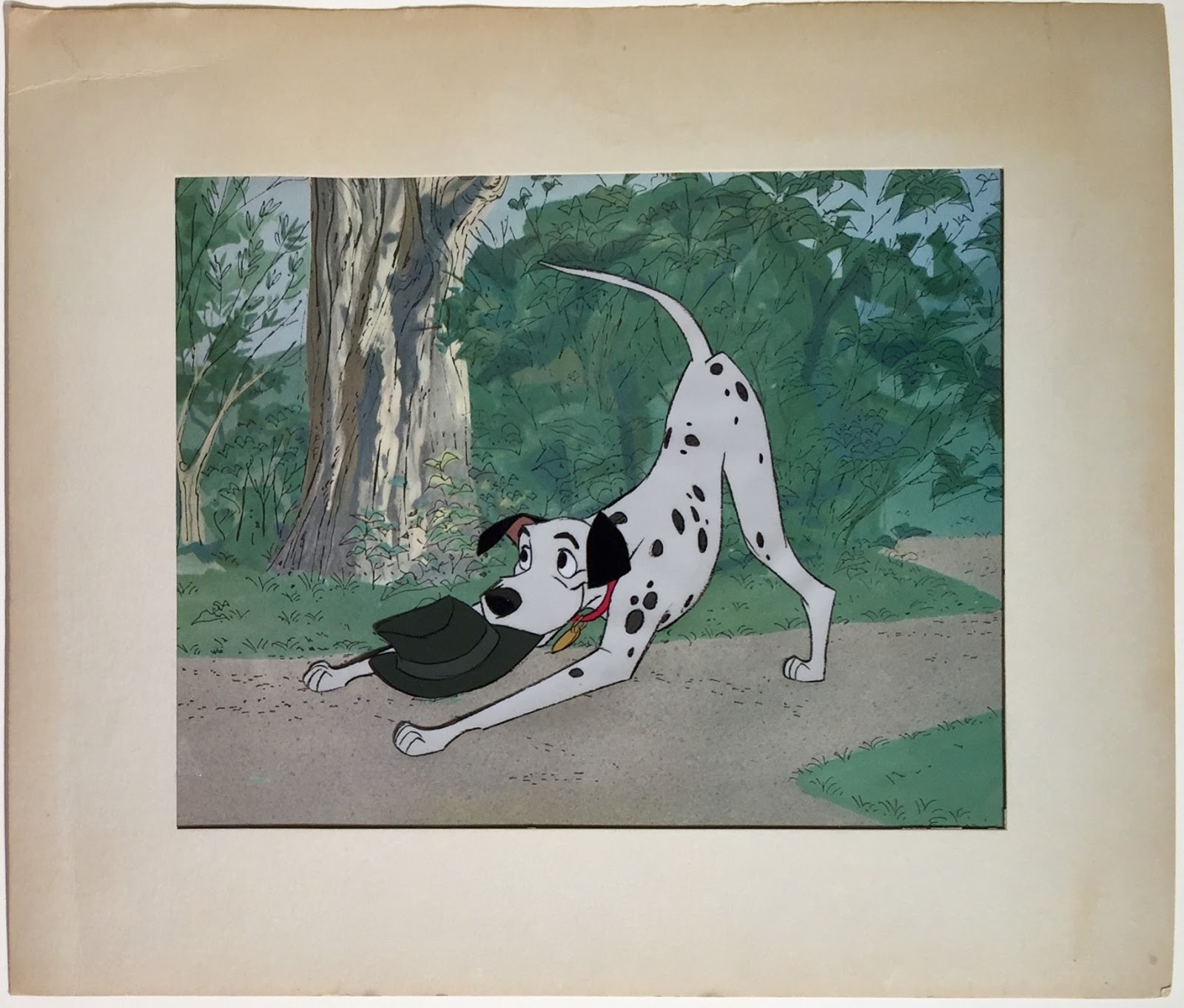
Original Production Animation Cel of Pongo With Roger's Hat From "One Hundred and One Dalmatians," 1961


Original hand painted production animation cel of Pongo with Roger's hat from "One Hundred and One Dalmatians," 1961, Walt Disney Studios; Set on a lithographic background; With original Art Corner Certificate sticker and custom engraved brass title plaque; Size - Pongo: 6 x 6 1/2", Image: 7 3/4 x 9 3/4"; Unframed.

To purchase this cel or to visit the Art Gallery, CLICK HERE!

"One Hundred and One Dalmatians" ("101 Dalmatians"), is a 1961 full length animated feature film by Walt Disney Productions. It was adapted from Dodie Smith's 1956 novel of the same name. It stars Rod Taylor as the voice of Pongo and Cate Bauer as the voice of Perdita; with Betty Lou Gerson as the voice of the evil and villainous Cruella de Vil. The animation of all the characters from the film was quite extraordinary.


Original hand painted production animation cel of Pongo with Roger's hat, still sealed in the original Art Corner mat.

The film "Sleeping Beauty," 1959 was very expensive to make and it took a huge financial loss at the box-office; as a result, the Disney animation studio was considering closing. During the production of "Sleeping Beauty," Walt Disney told animator Eric Larson: "I don't think we can continue, it's too expensive." Because Disney's entire company was based on animation, he was looking for a way to continue with animation, and at the same time significantly reduce costs.


Back of the sealed cel showing the Art Corner Gold sticker certificate.

The animator Ub Iwerks had been experimenting with Xerox photography to aid in animation process. By 1959 he had modified a Xerox camera to transfer the drawings by the animators, directly onto animation cels. The process would preserve the spontaneity of the penciled drawings but eliminate the inking process, thus saving time and money. However, the limitation was that the camera was unable to deviate from a black scratchy outline, and the resulting cels lacked the fine lavish quality of hand inking.


Close up of the Art Corner Gold sticker certificate.

One of the enormous benefits of the Xerox was that it was a tremendous help towards animating the spotted dalmatian dogs. According to famed animator Chuck Jones, Disney was able to complete the film for about half of what it would have cost if they had had to animate all the dogs and spots. To achieve the spotted dalmatians, the Disney animators envision the spot pattern as a star constellation. Once they had an "anchor spot," the next spot was placed into the pattern, and so on until the fully spotted dalmatian was achieved. All totaled, the film featured 6,469,952 spots, with Pongo having 72 spots, Perdita 68, and each puppy 32.


Custom engraved brass title plaque.

Pongo was animated by Ollie Johnston and voiced by Rod Taylor, who was an Australian TV an movie actor who appeared in over 50 films. This is a wonderful original production animation cel of Pongo with Roger's hat in his mouth. Pongo's tail in the air, he is full figure, eyes open, and in a great playful pose while playing with Roger in the park. This would certainly make a great addition to any animation art collection!

Wednesday, December 28, 2016

Original Production Animation Drawings of Flora, Fauna, and Merryweather from "Sleeping Beauty," 1959


Original production animation drawings of Flora, Fauna, and Merryweather in graphite and red pencils from "Sleeping Beauty," 1959, Walt Disney Studios; Numbered A95, 127, and C-202 in pencil lower right; Size - Flora: 6 1/2 x 4", Fauna: 6 3/4 x 4", Merryweather: 6 x 4 1/2", Sheets 12 1/2 x 15 1/2"; Unframed.

To purchase these drawings or to visit the Art Gallery, CLICK HERE!

Flora: "Make it pink!"
Merryweather: "Make it blue!"
Fauna: "Oh, I just love happy endings."

"Sleeping Beauty," 1959 is an animated musical film produced by Walt Disney based on two stories: "The Sleeping Beauty" by Charles Perrault and "Little Briar Rose" by The Brothers Grimm. The film was released to theaters on January 29, 1959, by Buena Vista Distribution. This was the last Disney adaptation of a fairy tale for 30 years because of its initial mixed critical reception and because of under performance at the box office. The next Disney adaption of a fairy tale would not occur until 1989 with "The Little Mermaid."

"Sleeping Beauty" was directed by Les Clark, Eric Larson, and Wolfgang Reitherman; under the supervision of Clyde Geronimi. Additional story work was by Joe Rinaldi, Winston Hibler, Bill Peet, Ted Sears, Ralph Wright, and Milt Banta. The film's musical score and songs, featuring the work of the Graunke Symphony Orchestra under the direction of George Bruns, are arrangements or adaptations of numbers from the 1890 "Sleeping Beauty Ballet" by Pyotr Ilyich Tchaikovsky. "Sleeping Beauty" was the first animated film to be photographed in the Super Technirama 70 widescreen process, as well as the second full-length animated feature film to be filmed in anamorphic widescreen (following "Lady and the Tramp" four years earlier). The film was presented in Super Technirama 70 and 6-channel stereophonic sound in first-run engagements.

Flora, Fauna and Merryweather are Princess Aurora's Fairy Godmothers, who appear at baby Aurora's christening to present their gifts to her, as well as go on to become her guardians. The Fairies were voiced by Verna Felton (Flora), Barbara Jo Allen (Fauna), and Barbara Luddy (Merryweather). Verna Felton also voiced Queen Leah, Aurora's mother; and had prior roles as Dumbo's mother in "Dumbo," the Fairy Godmother in "Cinderella," the Queen of Hearts in "Alice in Wonderland," and Aunt Sarah in "Lady in the Tramp." Barbara Luddy had previously voiced Lady in "Lady and the Tramp." The principle animator for the Three Fairies was Ollie Johnston and a little known fact is that one of the actresses who was one of the live action models for the Good Fairies was Frances Bavier, the future Aunt Bee on "The Andy Griffith Show." 


Original production animation drawing of Fauna, showing the entire sheet.

Fauna is the middle Fairy and is dressed in a green gown, a green hat, and a green cape clipped with a green triangle. Her gift to Aurora is the gift of song.


Original production animation drawing of Flora, showing the entire sheet.

Flora is the tallest and oldest Fairy, dressed in a red gown (although she is obsessed with the color pink), a red hat, and a red cape clipped with a yellow square. She is the strongest-willed leader of the group, and her gift to Aurora is the gift of beauty. She also created for Prince Phillip the powerful Sword of Truth and the invulnerable Shield of Virtue, for his escape and battle with Maleficent.


Original production animation drawing of Merryweather, showing the entire sheet.

Merryweather is the shortest and youngest Fairy, dressed in a blue gown, a blue hat, and a blue cape clipped with a blue circle. She is the Fairy who is the most verbal and aggressive towards Maleficent, and she is much bolder than the other two Fairies. As Merryweather is about to give her gift, Maleficent makes her appearance and curses Aurora to die when she touches a spinning wheel's spindle before the sun sets on her sixteenth birthday. Merryweather's gift to Aurora is to weaken Maleficent's curse so that instead of death, Aurora will fall into a deep sleep until she is awakened by true love's kiss.

This is a wonderful drawing set of all three Good Fairies, Flora, Fauna, and Merryweather from the Walt Disney masterpiece "Sleeping Beauty," 1959. All three Fairies are full figure, eyes open, and are large centered drawings.

Friday, December 23, 2016

Original Production Animation Cel of the Evil Queen Over A Courvoisier Background From "Snow White and the Seven Dwarfs," 1937


Original hand painted and hand inked production animation cel of the Evil Queen over a Courvoisier air brush background from "Snow White and the Seven Dwarfs," 1937, Walt Disney Studios; Size - Evil Queen: 7 1/4 x 6", Image 8 1/4 x 8 1/4", Frame 21 3/4 x 21 1/2"; Framed using a silver wood frame, two acid free mats and plexiglass.

To purchase this cel or to visit the Art Gallery, CLICK HERE!

 "Snow White lies dead in the forest. The huntsman has brought me proof. Behold, her heart." - Evil Queen

Development on Snow White and the Seven Dwarfs began in early 1934, and by June Walt Disney announced to The New York Times the production of his first feature, to be released under Walt Disney Productions. Before Snow White and the Seven Dwarfs, the Disney studio had been primarily involved in the production of animated short subjects in the Mickey Mouse and Silly Symphonies series. However, Disney hoped to expand his studio's prestige and revenues by moving into features, and he estimated that Snow White and the Seven Dwarfs could be produced for a budget of $250,000 (this was ten times the budget of an average Silly Symphony).

Snow White and the Seven Dwarfs was to be the first full-length cel animated feature in motion picture history, and as such Walt Disney had to fight to get the film produced. Both his brother and business partner Roy Disney, as well as his wife Lillian attempted to talk him out of it. The Hollywood movie industry mockingly referred to the film, while is was in production, as "Disney's Folly." Disney ended up having to mortgage his house to help finance the film's production, which would eventually ran up to a total cost of $1,488,422.74; an absolutely massive sum for a feature film in 1937!

After a long and difficult four years, on January 13, 1938, Snow White and the Seven Dwarfs made its New York premiere at Radio City Music Hall. The film ran for five weeks in a row, the first motion picture to do so, and it could have played longer if not for prior commitments of the venue. It was to be the theatres' most successful engagement in all of the 1930s. The film was loved by everyone and Disney, along with his animation team, had managed to make an animated film that the audience would believe! The crowd would be sad and cry when Snow White bit the apple and was placed in a glass casket; and they would laugh, smile, and be happy during the song and dance numbers with the Dwarfs. However, Disney was criticized by some for making a very scary film for children.

When the movie was played at Radio City Music Hall on its first release, the theater managers had to replace the music played when Snow White runs into the Dark Forest; because they were nervous that the kids would be too frightened upon hearing it. Snow White's run into the Forest had another result;  young children were still so scared by the sequence, that they wet their pants. As a result, the velvet upholstery of each and every seat held by a child, had to be replaced prior to every showing of the film.

The Walt Disney film's version of the Evil Queen changing into an Old Hag is very different compared to the original story. In the Disney version, the Queen uses her dark magic powers to actually transform herself into an old woman instead of just taking on a disguise; as in the Brothers Grimm story. Animation provided a transformation scene that is truly spectacular and the Disney team even made the event greater by utilizing the multi-plane camera; to make the room itself appeared to spin. This sequence along with the flight of Snow White through the Dark Forest; caused the British Board of Film Censors (now, the British Board of Film Classification) to give the film an A-certificate (children had to be accompanied by an adult) upon its original release. This resulted in a nationwide controversy as to whether the Forest and the Witch were too frightening for younger audiences. Nevertheless, most local authorities simply overrode the censor's decision and gave the film a U-certificate (Suitable for children).

Walt Disney's response to the idea that the film was too frightening for children was, "I do not make films primarily for children. I make them for the child in all of us, whether we be six or sixty." This may have been his statement, but he never made another film with such a scary villain. Every film after Snow White had the main villain accompanied by a comedic sidekick; such as Maleficent and her Goons, Cruella de Vil with Horace and Jasper, or Medusa with Snoops.

The Evil Queen, one of the greatest Walt Disney animated villains of all time, was animated by the famous Disney animator Art Babbitt. Babbitt was already an accomplished animator prior to working on "Snow White." He was known for creating the character of Goofy and for his work on "The Country Cousin," which won an Academy Award for the Disney Studio in 1936. The villain for Snow White was the Evil Queen; which Walt Disney and Joe Grant (Walt Disney character designer and story artist) had conceived as a blend of Lady Macbeth and the Big Bad Wolf, as well as traits inspired by actresses Joan Crawford and Gale Sondergaard. Refinement of the Queen was done by animators Grim Natwick and Norm Ferguson; however the actual animation of the Queen fell to Babbitt.

Rotoscoping, a technique used in animation whereby live actors are used to portray the characters and then animators trace over the footage frame by frame; was not used as much on the Queen as it was for the character of Snow White. Babbitt preferred to avoid rotoscoping and instead draw the character free hand. It has been stated that you could wallpaper a room with just drawings that Babbitt made just of her mouth and eyes; because all of the Queen's emotions came through her face. The Evil Queen, wonderfully voiced by veteran stage actress Lucille La Verne; holds a place in history as being the first character to ever speak in a full length animated film.


Framed Evil Queen original production animation cel.

This is an absolutely stunning original production animation cel of the Evil Queen holding the Heart Box. It is from the scene after she ordered her Huntsman to kill Snow White and then, as proof, bring back her heart in a bejeweled box that the Queen gave him. The Huntsman is unable to kill Snow White, but the Queen is unaware of this, and she goes before her Magic Mirror to ask "Who NOW is the fairest one of all?" When the Mirror replies that Snow White is the fairest one of all, the Queen holds up the box and opens it's lid stating, "Snow White lies dead in the forest. The Huntsman has brought me proof. Behold, her heart." This is a beautiful eyes and mouth open cel of the Evil Queen holding the Heart Box; and certainly it is one of the most desirable cels to own by any Walt Disney, Snow White, or Villains collector! The complete dialog from the scene is below:

Evil Queen: "Magic Mirror on the wall, who now is the fairest one of all?"
Magic Mirror: "Over the seven jewelled hills, beyond the seventh fall, in the cottage of the seven dwarfs, dwells Snow White, fairest one of all."
Evil Queen: "Snow White lies dead in the forest. The huntsman has brought me proof. Behold, her heart."
Magic Mirror: "Snow White still lives, the fairest in the land. 'Tis the heart of a pig you hold in your hand."
Evil Queen: "The heart of a pig?! Then I've been tricked!"

Wednesday, December 21, 2016

Original Production Animation Cel of The Blue Fairy from "Pinocchio," 1940


Original hand painted and hand inked production animation cel of the Blue Fairy from "Pinocchio," 1940, Walt Disney Studios; Set on a hand prepared custom background; Size - Blue Fairy: 6 1/4 x 5 3/4", Image 8 x 8 1/2", Frame 20 1/2 x 18 1/2"; Framed with two acid free mats, gold wood frame, custom engraved brass title plaque, and plexiglass.

To purchase this cel or to visit the Art Gallery, CLICK HERE!

"You see, Pinocchio, a lie keeps growing and growing until it's as plain as the nose on your face." - Blue Fairy

"Pinocchio," 1940 was the second animated feature film produced by Disney, and followed on the success of "Snow White and the Seven Dwarfs." 1937. It was released to theaters by RKO Radio Pictures on February 23, 1940 and was based on the Italian children's novel "The Adventures of Pinocchio" by Carlo Collodi. The general plot of the film involves an old wood-carver named Geppetto, who carves a wooden puppet that he names Pinocchio. One night the puppet is brought to life by the Blue Fairy, who informs him that he can become a real boy if he proves himself to be "brave, truthful, and unselfish". Pinocchio's journey to become a real boy is challenged by his encounters with an array of scrupulous characters.


Close up of the original production animation cel of the Blue Fairy.

"Pinocchio" became the first animated feature to win an Academy Award; it won for both Best Music - Original Score and for Best Music - Original Song for "When You Wish Upon A Star." Most critics and audiences agree that "Pinocchio" is among the finest Disney features ever made, and one of the greatest animated films of all time. In 1994, it was added to the United States National Film Registry as being "culturally, historically, or aesthetically significant."

In a story meeting for the upcoming film "Pinocchio" on January 12, 1939, Walt Disney stated that the Blue Fairy was to "give the appearance of loveliness... (but not look like) a glamour girl." The early model sheets and preliminary sketches reflect this idea, depicting the character as an ethereal beauty with swirling, billowing clothes and loose, unkempt hair (to reflect the fact that the fairy has literally flown into the scene). At some point in development, the design was changed to a less ethereal figure with human proportions. This final version of the character, with her glittery dress, solid hair, and more human proportions, suggested the inspiration of Jean Harlow (the American actress and sex symbol of the 1930's who was dubbed the "Blond Bombshell") and thus ultimately resembling the 'glamour girl' Walt Disney had initially tried to avoid. However, Disney seemed pleased with this version of the character, whose newly-found sexual allure worked on both Jiminy Cricket and the male animators working on the film, who reportedly whistled on first seeing a color test of the Blue Fairy.


Framed original production animation cel of the Blue Fairy.

Jack Campbell's animation of the Blue Fairy closely followed live-action footage of Marge Champion (who was also the performance model for Snow White) under the direction of Hamilton Luske. The Blue Fairy, was the only female character (besides Cleo the fish) in the film "Pinocchio" and was voiced by Evelyn Venable, an American actress. Evelyn was also the model for the first ever Columbia Pictures Torch Lady.

Oskar Fischinger, a famous abstract filmmaker from Germany, who had been hired by Disney primarily to help with "Fantasia's" opening sequence of Toccata and Fugue in D Minor composed by Johann Sebastian Bach. The segment consisted of live-action of the orchestra playing the piece, illuminated by abstract light patterns set in time to the music and backed by stylized and superimposed shadows. Fischinger went on to be responsible for animation of the Blue Fairy's magic, including the effects surrounding her when she first enters Geppetto's workshop and the beams of light eminating from the Blue Fairy's wand.


Close up of the custom engraved brass title plaque.

This is an extremely rare original production cel of the Blue Fairy. The cel is from one of the greatest scenes in the film, which occurs after Pinocchio has become Stromboli's star attraction as a marionette who is able to sing and dance without strings. Pinocchio wants to go home, but Stromboli locks him inside of a birdcage. Jiminy Cricket arrives to try and help him, but is unable to free Pinocchio from the cage. Suddenly the Blue Fairy appears, and asks Pinocchio why he is not in school. Although Jiminy urges Pinocchio to tell the truth, he starts telling lies; which causes his nose to grow longer and longer. This cel is from that famous scene when Pinocchio is telling the Blue Fairy that he wasn't in school because he had met somebody, two big monsters with green eyes. The Blue Fairy then asks, "Monsters? Weren't you afraid?" This is a wonderful cel from that exact point in the film. Original production cels of the Blue Fairy are very rare, with only a handful existing in the open market. The image of her is absolutely spectacular; she is eyes and mouth open, holding her magic wand, and her wings are clearly visible. This would make a great addition to any serious animation art collection! The complete dialog for the scene is below:

Blue Fairy: "Pinocchio, why didn't you go to school?"
Pinocchio: "I was going to school till I met somebody."
Blue Fairy: "Met somebody?"
Pinocchio: "Yeah. Two big monsters... with big, green eyes."
Blue Fairy:  "Why... Monsters? Weren't you afraid?"
Pinocchio: "No, ma'am, but they tied me in a big sack."
Blue Fairy: "You don't say!" And where was Sir Jiminy?"
Pinocchio: "Oh. Jiminy?"
Jiminy Cricket: "Leave me out of this."
Pinocchio: "They put him in a little sack."
Blue Fairy: "No!"
Pinocchio: "Yeah!"
Blue Fairy: " How did you escape? - I didn't."
Pinocchio: "They chopped me into firewood! Oh! Oh, look! My nose! What's happened?"
Blue Fairy: "Perhaps you haven't been telling the truth, Pinocchio."
Pinocchio: "Oh, but I have. Every single word! Oh, please, help me. I'm awful sorry."
Blue Fairy: "You see, Pinocchio, a lie keeps growing and growing until it's as plain as the nose on your face."