Translate

Monday, June 24, 2019

Original Production Animation Cel of Napoleon and Lafayette from "The Aristocats," 1970


Original hand painted production animation cel of Napoleon and Lafayette from "The Aristocats," 1970, Walt Disney Studios; Set on a lithographic background; Numbered R40 in ink lower right; Size - Napoleon, Lafayette, and Edgar's Motorcycle Sidecar: 8 x 14 1/4", Image: 11 1/4 x 14 1/4"; Unframed.

To purchase this cel or to visit the Art Gallery, CLICK HERE!

"Step of the gas Napoleon!" - Lafayette  

"The Aristocats," 1970 is an animated feature film produced and released by Walt Disney Productions.  This was the last film project to be approved by Walt Disney himself, as he died in late 1966, before the film was finally released to theaters by Buena Vista Distribution on December 11, 1970. "The Aristocats" featured the voice talent of Eva Gabor, Hermione Baddeley, Phil Harris, Dean Clark, Sterling Holloway, Scatman Crothers, and Roddy Maude-Roxby.

The film is based on a story by Tom McGowan and Tom Rowe, and centers around a family of aristocratic cats. After the mistress's butler kidnaps them (to gain his mistress' fortune which was intended to go to the cats) an unlikely alley cat acquaintance helps them escape and be returned to their home.  

It is Paris 1910 and Madame Bonfamille tells her lawyer Georges Hautecourt that she has decided to leave all of her stocks, bonds, mansion, treasures, jewels, and her entire fortune to her beloved cats rather than to her butler, Edgar Balthazar.  When Edgar overhears this he fears the cats will outlive him, and that he will never see a penny of the inheritance.  He then realizes that he has to get rid of the cats; "I'll be gone, no oh no... they'll be gone," he says.  Edgar decides to put sleeping tablets into the cats milk and when they fall asleep, he takes them in a covered basket on his motorcycle far away from the city of Paris. 

The two dogs Napoleon a Bloodhound and Lafayette a Bassett Hound, were both animated by Frank Thomas. The dogs were initially going to be in only one scene, but because it was so successful; a second scene was developed involving Edgar returning to the French countryside in order to collect his umbrella and bowler hat. Napoleon and Lafayette were voiced by Pat Buttram and George Lindsey, respectively. The two voice actors would later reunite in "Robin Hood" to provide the voices for the Sheriff of Nottingham and Trigger the vulture guard; and again in "The Rescuers" as Luke and Deadeye.


Original production animation cel of Napoleon and Lafayette without the background.

The character of Edgar was voiced by Roddy Maude-Roxby, an accomplished English actor.  He was just wonderful in the role with the delightful snooty English butler voice, that could also morph into a scheming cunning timber perfect for a Disney Villain.
This cel of Napoleon and Lafayette appears in the scene when Edgar first makes his appearance at their abandoned windmill site in the French countryside, in order to dispose of Duchess and her kittens. A hilarious chase scene occurs between the two dogs and Edgar riding his motorcycle with attached sidecar. This is a large, rare, and wonderful cel of an eyes and mouths open image of Napoleon pushing and running behind Lafayette riding in Edgar's side car. A great addition to any animation art collection!

Sunday, June 23, 2019

Original Production Animation Cels of Ursula and her Tentacles from "The Little Mermaid," 1989


Original hand painted matching production animation cels of Ursula and her Tentacles numbered W5 and T5 set on a lithographic background from "The Little Mermaid," 1989, Walt Disney Studios; Walt Disney seal upper right; Size - Ursula: 5 1/4 x 8 3/4", Image 8 x 12 3/4"; Unframed.


"She (Ariel) may be the key to Triton's undoing" - Ursula

"The Little Mermaid," 1989 was the final Disney film using hand painted animation cels. Disney Studios, specifically Ron Clements and John Musker, adapted the Hans Christian Anderson story to give the villain a much bigger role. The first choice to voice the character was Beatrice Arthur who turned down the part. It was eventually accepted by veteran stage actress Elaine Stritch; however she clashed with the music stylist. The voice was finally given to Pat Caroll who described the role as, "part Shakespearean actress, with all the flair, flamboyance and theatricality, and part used-car salesman with a touch of con artist." Caroll also served as the live action model of the character.


Original production cel of Ursula without the background.


Original production cel of Ursula's Tentacles without the background.

The animation of the character was initially offered to Glen Keane, however after hearing Jodi Benson sing "Part of Your World" he wanted to animate Ariel instead and so Ursula ended up going to Disney animator, Ruben Aquino. Aquino credits Ursula as his favorite character in which he has ever worked and said, "When animating Ursula, I was inspired mainly by the voice and by the story sketches, but of course, I also worked very closely with the directors (John Musker and Ron Clements) to realize their vision. Given a great voice, the scenes almost animate themselves, and that definitely was the case with Pat Carroll's amazing vocal performance. I also did a lot of research on octopus locomotion to make sure Ursula's movements were convincing."


Close up of the Walt Disney Seal.

This is a matched two cel setup of Ursula's body, and a cel of her tentacles. The image of her is perfect and the cels appear at the end of Ursula's first appearance in the film, when she realizes that Ariel (King Triton's daughter) may be able to be manipulated. The dialog for the cel is below:

"She (Ariel) may be the key to Triton's undoing" - Ursula

Saturday, June 22, 2019

Original Production Animation Cel of Shere Khan and Kaa from "The Jungle Book," 1967


Original hand painted production animation cels of Shere Khan and Kaa from "The Jungle Book," 1967, Walt Disney Studios; Set on a lithographic background; Numbered 95 and 339 in ink lower right; Walt Disney seal lower left; Size - Shere Khan: 7 x 5 1/2",  Kaa: 4 1/2 x 6 1/4", Image 10 1/4 x 15"; Unframed.

To purchase this cel or to visit the Art Gallery, CLICK HERE!

"Yes? Yes? Who is it?" - Kaa
"It's me, Shere Khan. I'd like a word with you if you don't mind." - Shere Khan

"The Jungle Book," 1967 was the nineteenth animated feature film produced by Walt Disney Productions and inspired by Rudyard Kipling's book of the same name. The film was directed by Wolfgang Reitherman, it was to be the last film that was worked on by Walt Disney, as he passed away during its production. The film follows Mowgli, a feral child raised in the Indian jungle by wolves, as he encounters Bagheera the panther and Baloo the bear; who try and convince him to leave the jungle before the villainous tiger Shere Khan finds him. Voice actors include: Phil Harris, Sebastian Cabot, George Sanders and Louis Prima; as well as Disney regulars such as Sterling Holloway, J. Pat O'Malley, Verna Felton, and the director's son, Bruce Reitherman, as the voice of Mowgli.

"The Jungle Book" was released on October 18, 1967, with noted acclaim for its soundtrack that featured eight original songs: seven by the Sherman Brothers and one by Terry Gilkyson. Longtime Disney collaborator Gilkyson was the first songwriter to complete several songs which followed Kipling's book closely; however Walt Disney felt that the works were too dark. The only piece of Gilkyson's work which survived to the final film, was his very upbeat song "The Bare Necessities." The Sherman Brothers were then brought in to do a complete rewrite. Disney frequently brought the composers to the storyline sessions, and asked them to "find scary places and write fun songs" that fit into the story and advanced the plot. The popular success of the film in undoubtedly due to both the music and songs, that were primarily written by the Sherman Brothers.


Shere Khan original production animation cel without the background.

Wolfgang Reitherman began working for Walt Disney in 1934, along with future Disney legends Ward Kimball and Milt Kahl. Reitherman worked on various Disney feature films produced from 1937 to 1981, including "Snow White and the Seven Dwarfs" (animating the Slave in the Magic Mirror) up to "The Fox and the Hound," where he was the co-producer. Beginning with 1961's "One Hundred and One Dalmatians," "Woolie", as he was called by friends, served as Disney's chief animation director. In addition to "101 Dalmatians," Reitherman directed "The Sword in the Stone" (1963), "The Jungle Book" (1967), "The Aristocats" (1970), "Robin Hood" (1973) and "The Rescuers" (1977).

One of Reitherman's productions, the 1968 short "Winnie the Pooh and the Blustery Day," won the Academy Award for Best Animated Short Film. In addition, all three of Reitherman's sons — Bruce, Richard, and Robert provided voices for Disney characters, including Mowgli in "The Jungle Book," Christopher Robin in "Winnie the Pooh and the Honey Tree," and Wart in "The Sword in the Stone." Not only did Bruce Reitherman provided the voice of Mowgli in "The Jungle Book," but he also acted out certain scenes as live action reference for the animators. The character of Mowgli was animated by quite a few animators, however Milt Kahl set the final design and the majority of Mowgli's scenes were animated by Frank Thomas and Ollie Johnston.

Shere Khan, a Bengal tiger, is the main antagonist in the 1967 Walt Disney film "The Jungle Book;" an adaption of writer Rudyard Kipling's series of stories. Khan was voiced by George Sanders, a veteran actor with a deep bass voice and a heavy British accent. According to Frank Thomas and Ollie Johnston from "The Disney Villain":

"The perfect choice for the voice was George Sanders, the complete cynic, who added the element of boredom. With this voice, we could imagine a tiger who would kill without concern or effort. Sanders was asked if he would like a drawing of Shere Khan as a souvenir, to which he responded, "I suppose so." Asked further if he would like Walt to autograph it, he replied, "How utterly absurb. Why would I want his signature? He might want mine, I created the character."


Kaa original production animation cel without the background.

The next two paragraphs are excepts from "The Disney Villain," by Frank Thomas and Ollie Johnston:

"It is not often that true villains as unique as Kaa and Shere Khan confront each other. In "The Jungle Book" the meeting was not a a victim-villain relationship because thy had nearly equal strengths. It was more a game of "keep away." Kaa will not admit that he has Mowgli hypnotized high in the tree as the tiger suspects. In a cold but polite manner Shere Khan tries to intimidate the crafty Kaa by suggesting, 'I thought you might be entertaining someone up there in your coils.'"

"The tiger is almost unbeatable, but he is unable to find out if Mowgli is really up in the tree. Any other character would have been terrified by the treatment Kaa is receiving, yet the snake continues to be evasive. He is a slippery antagonist, withstanding threats and humiliation in order to keep Mowgli for himself. It is an entertaining standoff for these two powerful predators, but it is Mowgli who eventually wins the day."


Close up of the Walt Disney seal.

Milt Kahl, the great veteran Disney animator, was in charge of bringing Shere Khan to life and so of course Kahl set out on a crash course in tigers. Kahl said in an interview:  I learned so much about tigers by studying them that I didn't have to rely on any life action crutch." From Disney animator Andreas Dejas about the animation of Shere Khan, "Great perspective walk, and I love the way the tiger lies down, upper body first, then the rear. The way he moves those front feet is worth studying alone. Such great anatomy."

Kaa, which means "snake" in Hindi, is a python who is almost always hungry and is known for being persuasive and tricky. He lives mainly in the upper limbs of trees and has the ability to hypnotize other creatures through eye contact. Kaa is often seen pursuing Mowgli, in an attempt to devour the man-cub, and he was animated by both Frank Thomas and by Milt Kahl.

Kaa was the second character who was originally voiced by Sterling Holloway, the first being Winnie-the-Pooh. Holloway's voice is just so wonderful in tone and pitch, and it is hard to imagine any other person doing the character justice. Kaa is very similar to another snake character, Sir Hiss from "Robin Hood". The two share several traits as both use hypnosis, and both suck up to the film's main antagonist (Shere Khan in Kaa's case, and Prince John in Sir Hiss's case). Exceptions are that they are different colors, sizes, and Sir Hiss wears a cape and hat.

This wonderful pair of original production cels are from one of the most memorable scenes in the entire film; when Shere Khan finds Kaa and tries to find out the whereabouts of Mowgli the Man Cub. Shere Khan and Kaa are great large images, and both characters are eyes and mouth open. A spectacular setup of the evil tiger finding and getting ready to interrogate Kaa the python. It really does not get better! The dialog for this scene is below:

Kaa: Yes? Yes? Who is it?
Shere Khan: "It's me, Shere Khan. I'd like a word with you if you don't mind."
Kaa: "Shere Khan. What a surprise."
Shere Khan: "Yes, isn't it? I just dropped by. Forgive me if I've interrupted anything."

Original Production Animation Cel of Lucifer from "Cinderella," 1950


Original hand inked and hand painted production animation cel of Lucifer set on a lithographic background from "Cinderella," 1950, Walt Disney Studios; Production numbers in ink lower center; Size - Lucifer: 4 1/2 x 6 1/2", Image 11 1/4 x 15 1/4"; Unframed.


The 1950 Walt Disney feature film "Cinderella" was based on the French version of the tale by Charles Perrault, entitled "Cinderella" and written in 1698. The film was the second in the series of great Princess films developed by Disney, the first being Snow White in 1937. The character of Cinderella is usually front and center in the pantheon of Disney Princess merchandise, perhaps because she is the only Princess not to be of a noble blood line who ended up marrying a Prince and becoming royalty.

Lucifer was the name of the pet cat of Lady Tremaine, Cinderella's evil Stepmother. The name Lucifer, a synonym of Satan, was chosen by Walt Disney himself probably due to his known hatred of cats. Lucifer was largely created for comic relief from the main storyline of Cinderella. Ward Kimball, the animator for Lucifer, was also responsible for the comedic subplot of the cat-and-mouse chase scenes between the cat and the two featured mice of the film, Jaq and Gus. His design for Lucifer was largely inspired by a pet cat belonging to Kimball himself; and Kimball's excellent animation skills have made Lucifer one of Disney's greatest Villains!


Original production animation cel of Lucifer without the background.

Lucifer was voiced by the very well known voice actress, June Foray. Foray worked for many different animation studios and is probably most well known as the voice of Cindy Lou Who, in Chuck Jone's holiday favorite "How The Grinch Stole Christmas," 1966. Chuck Jones is reported to have said, "June Foray is not the female Mel Blanc, Mel Blanc was the male June Foray."

This is a very large and expressive original production animation cel of Lady Tremaine's wicked and sinister cat, Lucifer. Original artwork of Lucifer is very rare and this is a great piece. He has his green eyes open, sporting a great wicked smile, and he is licking his lips with anticipation. This is a full cel with ink production numbers and Lucifer is a large 4 1/2 by 6 1/2 inches big. A rare and beautiful piece of vintage Walt Disney animation artwork from the full length feature film masterpiece "Cinderella!"

Saturday, May 4, 2019

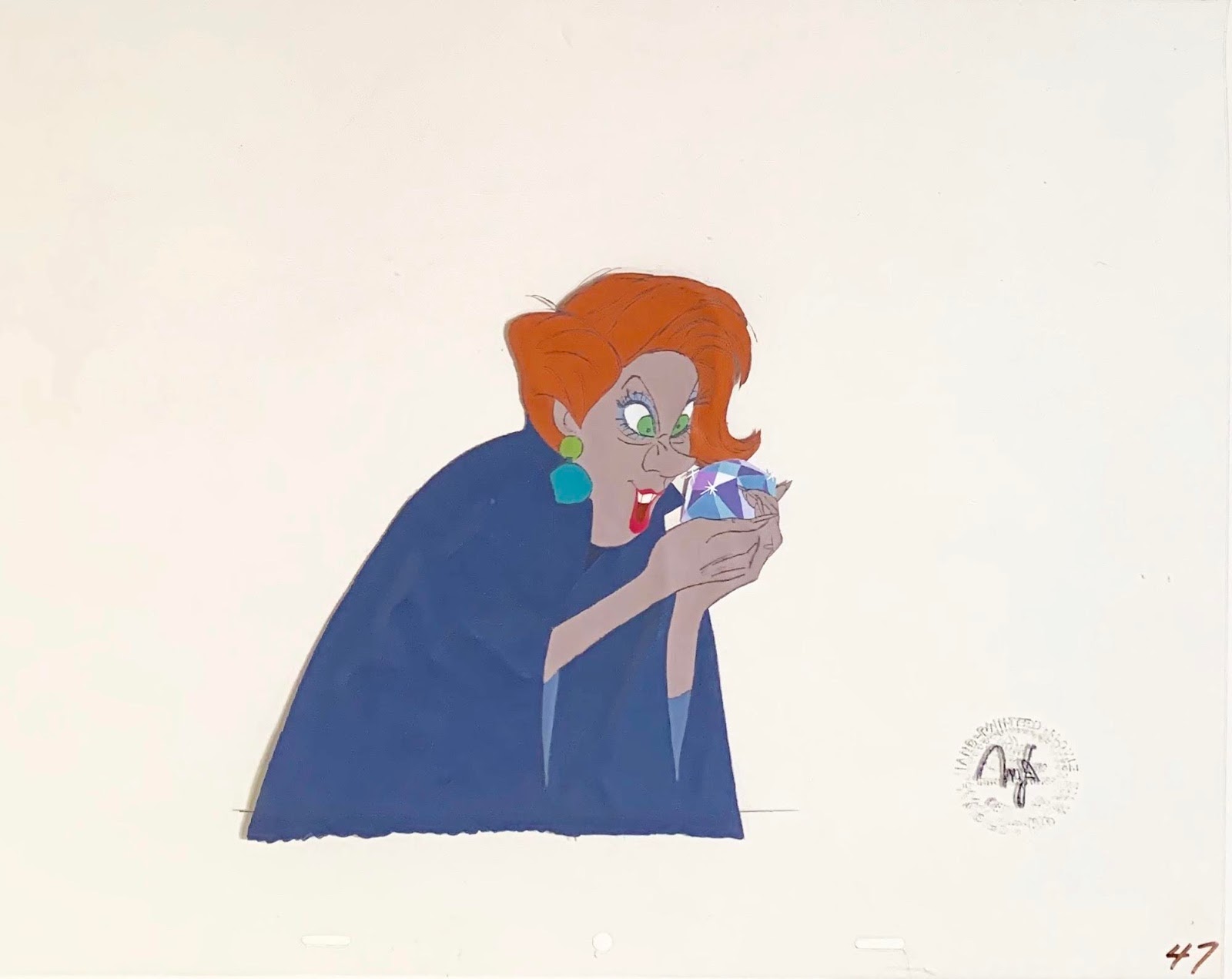
Original Production Animation Cel of Madame Medusa from "The Rescuers," 1977


Original hand-painted production animation cel of Madame Medusa holding The Devil's Eye Diamond from "The Rescuers," 1977, Walt Disney Studios; Numbered 47 in ink and Walt Disney seal lower right; Set on a lithographic background; Size - Madame Medusa: 7 x 6 1/4", Image 9 1/2 x 15 1/2"; Unframed.


"At last, the Devil's Eye!" - Madame Medusa

"The Rescuers" is an animated feature film produced by Walt Disney Productions; and was released on June 22, 1977 by Buena Vista Distribution. The film is based on a series of books by Margery Sharp, most notably "The Rescuers and Miss Bianca." The 23rd film in the Walt Disney Animated Classics series, the film is about the Rescue Aid Society; an international mouse organization headquartered in New York; and shadowed the United Nations. The Rescue Aid Society, a mouse based group, was dedicated to helping abduction victims around the world at large. Two of these mice, jittery janitor Bernard (voiced by Bob Newhart) and his co-agent, the elegant Miss Bianca (voiced by Eva Gabor), set out to rescue Penny, an orphan girl being held prisoner in the Devil's Bayou by treasure huntress Madame Medusa.

Early designs for Medusa were done by Ken Anderson, there were even discussions about bringing back Cruella deVil from "101 Dalmatians" as the villain; but that was eventually abandoned. The character of Medusa was eventually created and although there are many similarities with Cruella (thin build, similar cars, appear wealthy, bad tempers, cry upon realizing that they have lost, etc.), Medusa is still quite distinct with her wild red hair, sagging breasts, green eyes, and lots and lots of makeup. Her ultimate goal in the film is to possess the Devil's Eye, the world's largest diamond. Milt Kahl was given the task of animating Medusa and it is known that one his inspirations was his ex-wife. Kahl's brilliance in animation is really showcased with this character and many point to the scene where she is removing her false eyelashes as proof of his technical skill.


Original production animation cel of Madame Medusa without the background.


Close up of the Walt Disney seal and production number.

The next three paragraphs are from veteran Walt Disney animator Andreas Deja:
"When Milt Kahl was asked in an interview if he had a favorite character he animated, his response was: "Oh I enjoyed a few, I just loved doing Madame Mim, Shere Khan was a lot of fun, and so were the butler and old lawyer in 'Aristocats'. But I guess I enjoyed Medusa more than any one of them." And it shows. His last animation assignment at Disney -just like Marc Davis's- was a tour de force of character acting. It was a "I'm going to give it all" feel to it.

Marc told me that Milt promised him, Medusa will "wipe his Cruella off the screen". Then he added with a chuckle: "Of course that didn't happen". So there was definitely a friendly competition going on between these two great animators and their characters. Milt sort of designed Medusa's features opposite from Cruella's. Cruella has small nose, Medusa's is longer. Cruella's hair parts in the middle, Medusa's off to one side. Cruella has a pointy jaw, Medusa is almost chin less etc.

I have to admit, when I first saw Medusa in "The Rescuers" in a London theater, I couldn't believe my eyes. So much inventiveness in her drawing and motion. How on earth can you show an animated character removing her make up? Wasn't that something only a live actress could pull off...but in animation? Incredible! I have spent way too much time studying this character, on the other hand I think I got a lot out of it. Dialogue, graphic but dimensional drawing and just being gutsy in general."

When Madame Medusa is first introduced in the film "The Rescuers," she is barging into her back room of her pawn shop to answer a ringing telephone. "Madam Medusa's Pawn Shop Bou-tique," she says. Geraldine Page, the Oscar winning actress, provided the voice to this wonderful villain and the way that she increases her voice tone with the words pawn shop boutique is just so wonderful and extremely memorable.

This is an original production animation cel of Madame Medusa holding the Devil's Eye Diamond. The Devil's Eye is the world's largest diamond. It used to belong to Pirates that buried it, and the rest of their treasure, in a Devil's Bayou cavern. Penny, along with Bernard and Bianca, retrieve the diamond from a skull and hand it to Madame Medusa. Medusa, holding the diamond in her hands, exclaims "At last, the Devil's Eye!" This is a rare and wonderful image from the key scene in the film when Medusa finally acquires what she has been searching for throughout the entire film. Medusa is eyes and mouth open and she is staring into the sparkling diamond held her hands. A great addition to any animation art collection!

Saturday, April 13, 2019

Original production animation cel of Pinocchio from "Pinocchio," 1940


Original hand painted and hand inked production animation cel of Pinocchio from "Pinocchio," 1940, Walt Disney Studios; Set on a lithographic background; Size - Pinocchio: 4 1/2 x 2", Image 5 1/2 x 7"; Unframed.

To purchase this drawing or to visit the Art Gallery, CLICK HERE!

"Introducing... the only marionette who can sing and dance absolutely without the aids of strings! The one-and-only Pinocchio!" - Stromboli
"I've got no strings to hold me down." - Pinocchio

"Pinocchio," 1940 was the second animated feature film produced by Disney, and followed on the success of "Snow White and the Seven Dwarfs." 1937. It was released to theaters by RKO Radio Pictures on February 23, 1940 and was based on the Italian children's novel "The Adventures of Pinocchio" by Carlo Collodi. The general plot of the film involves an old wood-carver named Geppetto, who carves a wooden puppet that he names Pinocchio. One night the puppet is brought to life by the Blue Fairy, who informs him that he can become a real boy if he proves himself to be "brave, truthful, and unselfish". Pinocchio's journey to become a real boy is challenged by his encounters with an array of scrupulous characters.

"Pinocchio" became the first animated feature to win an Academy Award; it won for both Best Music - Original Score and for Best Music - Original Song for "When You Wish Upon A Star." Most critics and audiences agree that "Pinocchio" is among the finest Disney features ever made, and one of the greatest animated films of all time. In 1994, it was added to the United States National Film Registry as being "culturally, historically, or aesthetically significant."

Due to the huge success of "Snow White," Walt Disney wanted more famous voice actors for "Pinocchio." He cast popular singer Cliff Edwards (who had made the first record selling over a million copies) as Jiminy Cricket. Disney also wanted the character of Pinocchio to be voiced by a real child. The role ended up going to twelve year old actor Dickie Jones, who had previously been in Frank Capra's enormous Hollywood hit, "Mr. Smith Goes to Washington."

Animation began in September 1938 and just as in "Snow White," live-action footage was shot for "Pinocchio" with the actors playing the scenes; which was supervised by Hamilton Luske. The animators then used the footage as a guide for their animation drawings by studying the human movement and then incorporating many of those poses and scenes. The title character was animated by Milt Kahl (initial design), Frank Thomas, and Ollie Johnston. "When I was doing Pinocchio," Johnston said, "I thought of the character being real, a living person, not a drawing."

This is an exception original hand inked and hand painted production animation cel of Pinocchio from the scene when he first appears on the stage of Stromboli's Puppet Show. He is introduced by Stromboli and begins to sing the song "I've Got No Strings." The song's music was written by Leigh Harline and the lyrics were written by Ned Washington. This is a great full figure, eyes, and mouth open image of Pinocchio and a great addition to any animation art collection. The dialog for the scene is below:

"Introducing... the only marionette who can sing and dance absolutely without the aids of strings! The one-and-only Pinocchio!" - Stromboli
"I've got no strings to hold me down." - Pinocchio

Original Production Animation Cel of Jiminy Cricket set over a Courvoisier Background from "Pinocchio," 1940


Original hand painted and hand inked production animation cel of Jiminy Cricket from "Pinocchio," 1940, Walt Disney Studios; Set over a Courvoisier air brush background; Size - Jiminy Cricket: 6 x 3 1/2", Image 9 1/2 x 8 1/4"; Unframed.

To purchase this cel or to visit the Art Gallery, CLICK HERE!

Pinocchio: "What's a conscience?"
Jiminy Cricket: "What's a conscience! I'll tell ya! A conscience is that still small voice that people won't listen to. That's just the trouble with the world today..."

"Pinocchio," 1940 was the second animated feature film produced by Disney, and followed on the success of "Snow White and the Seven Dwarfs." 1937. It was released to theaters by RKO Radio Pictures on February 23, 1940 and was based on the Italian children's novel "The Adventures of Pinocchio" by Carlo Collodi. The general plot of the film involves an old wood-carver named Geppetto, who carves a wooden puppet that he names Pinocchio. One night the puppet is brought to life by the Blue Fairy, who informs him that he can become a real boy if he proves himself to be "brave, truthful, and unselfish". Pinocchio's journey to become a real boy is challenged by his encounters with an array of scrupulous characters.

"Pinocchio" became the first animated feature to win an Academy Award; it won for both Best Music - Original Score and for Best Music - Original Song for "When You Wish Upon A Star." Most critics and audiences agree that "Pinocchio" is among the finest Disney features ever made, and one of the greatest animated films of all time. In 1994, it was added to the United States National Film Registry as being "culturally, historically, or aesthetically significant."

Due to the huge success of "Snow White," Walt Disney wanted more famous voice actors for "Pinocchio." He cast popular singer Cliff Edwards (who had made the first record selling over a million copies) as Jiminy Cricket. Disney also wanted the character of Pinocchio to be voiced by a real child. The role ended up going to twelve year old actor Dickie Jones, who had previously been in Frank Capra's enormous Hollywood hit, "Mr. Smith Goes to Washington."

Animation began in September 1938 and just as in "Snow White," live-action footage was shot for "Pinocchio" with the actors playing the scenes; which was supervised by Hamilton Luske. The animators then used the footage as a guide for their animation drawings by studying the human movement and then incorporating many of those poses and scenes. The title character was animated by Milt Kahl (initial design), Frank Thomas, and Ollie Johnston. "When I was doing Pinocchio," Johnston said, "I thought of the character being real, a living person, not a drawing."

Jiminy Cricket was animated by Ward Kimball, with Joe Grant working up early rough model sketches.  Kimball would go on to work on many characters for the Walt Disney studios, including the Mad Hatter and Cheshire Cat in "Alice In Wonderland;" however the great Disney animators Frank Thomas and Ollie Johnston thought that Kimball's animation of Jiminy Cricket was "the most sincere he ever did."

From veteran Walt Disney animator Andreas Deja:
"Ward Kimball surely was looking forward to animating Jiminy Cricket, after the bad experience he just had on Snow White. His brilliantly animated "Soup Eating Sequence" had been cut from the film, and now it was time for a fresh start on the next feature film Pinocchio. Even though Walt Disney personally assigned the Cricket to Kimball, the animator didn't seem to be able to please the boss with his initial designs. Not appealing, too grotesque and insect like! After many revised versions in which Ward de-insectified the design, Walt finally approved a design that though very appealing had very little to do with the anatomy of a real cricket."

This is a wonderful original production animation cel of Jiminy Cricket placed on an original airbrushed Courvoisier background. Jiminy is full figure, eyes and mouth open, and he is wearing his top hat, tails, spats, and holding his umbrella. Just a great action pose of one of the greatest Disney characters of all time, and a great addition to any animation collection!