Translate

Monday, February 2, 2015

Production cel of Toby, Basil, Olivia, and Dr. Dawson from "The Great Mouse Detective," 1986


Original hand painted production cel of Toby, Basil of Baker Street, Olivia Flaversham, and Dr. David Q. Dawson set on a lithographic background that matches the scene from "The Great Mouse Detective," 1986; Disney seal lower right; Framed with a brown wood frame, three acid free mats, and UV conservation clear glass.


Eve Titus in a series of stories about Basil of Baker Street; a mouse that lived next door to Sherlock Holmes and who shared many of his skills and traits.  Although usually paned by critics, I adored the film and remember exactly where and with whom I saw the film.  I think one reason I liked the film so much is because I loved reading the real Sherlock Holmes stories by Arthur Conan Doyle.  


Close up of the mice on Toby's nose.

Toby, the Bassett Hound, is one of my favorite Disney Dogs!  He is lovable and fun and rolls on his back for scratching and like all dogs works for food; in his case cheese crumpets.  Toby is also obedient and being a Hound dog, is great at tracking.  In his cel, Basil, Dr. Watson, and Olivia are off to track down the whereabouts of Olivia's father; and here all three of those characters are standing on Toby's nose.  The detail is really incredible, given how small the figures!  You can see the magnifying glass is Basil's hand as well as the detail of his coat and deerstalker hat.  I have never seen another cel of Toby and the mice this nice in all my years of dealing and collecting!


Framed Great Mouse Detective Cel.

Wednesday, January 28, 2015

Drawing of Maleficent As A Dragon Breathing Fire from "Sleeping Beauty," 1959


Original production drawing of Maleficent as the Dragon from the 1959 full length animated feature film "Sleeping Beauty" from Walt Disney Studios.  Numbered "73" lower right and center; Unframed.


“Now you shall deal with me, o prince, and all the powers of HELL!”
―Maleficent before transforming into the Dragon

Wolfgang Reitherman (known as Woolie) began working for Walt Disney in 1934, and is credited in films from Pinocchio, 1940 (Monstro the Whale) to The Fox and the Hound, 1981 (co-producer).  His masterful animation work includes the climatic dinosaur fight in Igor Stravinsky's The Rite of Spring in Fantasia, the Headless Horseman chase in The Legend of Sleepy Hollow section in The Adventures of Ichabod and Mr. Toad, the Crocodile in Peter Pan, and of course Maleficent as a dragon in Sleeping Beauty.  An interesting side note is that all three of Reitherman's sons; Bruce, Richard, and Robert  provided voices for Disney characters, Mowgli in The Jungle Book, Christopher Robin in the Winnie the Pooh films, and Wart in The Sword in the Stone.

The climatic ending of Sleeping Beauty is the transformation of The Mistress of all Evil - Maleficent into a massive black and purple Dragon capable of breathing green fire.  Children were absolutely terrified of the Dragon, with her large teeth, powerful claws, and expansive wing span.  The success of the Dragon is owed to Reitherman's remarkable drawing and animation skills.  In this very large and powerful drawing, Maleficent's left claw in perched atop one of the pillars of the bridge that Prince Phillip is attempting to cross.  Her mouth is open and she is breathing green fire that strikes Phillip's shield.  This is an absolutely beautiful drawing, from one of the best sequences in the finale of the film!


Close up of Maleficent As A Dragon.

To view the scene which this drawing was used to create, click on the short video below:


Maleficent Drawing from "Sleeping Beauty," 1959 - "It's incredible! 16 years, and not a trace of her!"


Original production drawing of Maleficent in graphite and red pencil from "Sleeping Beauty," 1959; Numbered "364E" lower right and with animation ladder lower right; Size - Maleficent 5 1/4 x 9", Sheet 12 1/2 x 14 3/4"


If you ask people to name their favorite Disney Villain, chances are you will one of three answers; The Evil Queen/Witch from "Snow White and the Seven Dwarfs," Cruella DeVil from "101 Dalmatians," or Maleficent from "Sleeping Beauty."  Two of the three, Cruella and Maleficent, were created/drawn by the great animator Marc Davis.  Davis was part of what has been dubbed Disney's Nine Old Men; the core group of animators, some becoming directors, that created the finest animated films ranging from "Snow White and the Seven Dwarfs", 1937 to "The Rescuers", 1977.

The voice of Maleficent was performed by Eleanor Audley.  She had worked for Disney prior by also being the voice for the cold and calculating Lady Tremaine (The Stepmother) in "Cinderella."  If is known that Frank Thomas for Lady Tremaine and Marc Davis for Maleficent, incorporated facials features of Eleanor into both characters.   


Close up of Full Figure Maleficent Drawing.

This drawing is from the scene in Maleficent's Castle when Maleficent, is furious over the fact that her Goons (after 16 years) have not been able to find Princess Aurora and she screams, "It's incredible! 16 years, and not a trace of her! She couldn't have vanished into thin air! Are you sure you searched everywhere?"

To view the scene which this drawing was used to create, click on the short video below:


Tuesday, January 27, 2015

Original Production Animation Cel of the Evil Queen Over A Courvoisier Background From "Snow White and the Seven Dwarfs," 1937


Original hand painted and hand inked production animation cel of the Evil Queen over a Courvoisier air brush background from "Snow White and the Seven Dwarfs," 1937, Walt Disney Studios; Size - Evil Queen: 7 3/4 x 5 3/4", Image 9 1/4 x 7 3/4", Frame 29 1/2 x 26 1/4"; Framed using a black and gold wood frame, four acid free mats (the two outer suede) and UV conservation clear glass.

To purchase this cel or to visit the Art Gallery, CLICK HERE

"Magic Mirror on the wall, who now is the fairest one of all?" - Evil Queen


Development on Snow White and the Seven Dwarfs began in early 1934, and by June Walt Disney announced to The New York Times the production of his first feature, to be released under Walt Disney Productions. Before Snow White and the Seven Dwarfs, the Disney studio had been primarily involved in the production of animated short subjects in the Mickey Mouse and Silly Symphonies series. However, Disney hoped to expand his studio's prestige and revenues by moving into features, and he estimated that Snow White and the Seven Dwarfs could be produced for a budget of $250,000 (this was ten times the budget of an average Silly Symphony).

Snow White and the Seven Dwarfs was to be the first full-length cel animated feature in motion picture history, and as such Walt Disney had to fight to get the film produced. Both his brother and business partner Roy Disney, as well as his wife Lillian attempted to talk him out of it. The Hollywood movie industry mockingly referred to the film, while is was in production, as "Disney's Folly." Disney ended up having to mortgage his house to help finance the film's production, which would eventually ran up to a total cost of $1,488,422.74; an absolutely massive sum for a feature film in 1937!

After a long and difficult four years, on January 13, 1938, Snow White and the Seven Dwarfs made its New York premiere at Radio City Music Hall. The film ran for five weeks in a row, the first motion picture to do so, and it could have played longer if not for prior commitments of the venue. It was to be the theatres' most successful engagement in all of the 1930s. The film was loved by everyone and Disney, along with his animation team, had managed to make an animated film that the audience would believe! The crowd would be sad and cry when Snow White bit the apple and was placed in a glass casket; and they would laugh, smile, and be happy during the song and dance numbers with the Dwarfs. However, Disney was criticized by some for making a very scary film for children.


When the movie was played at Radio City Music Hall on its first release, the theater managers had to replace the music played when Snow White runs into the Dark Forest; because they were nervous that the kids would be too frightened upon hearing it. Snow White's run into the Forest had another result;  young children were still so scared by the sequence, that they wet their pants. As a result, the velvet upholstery of each and every seat held by a child, had to be replaced prior to every showing of the film.

The Walt Disney film's version of the Evil Queen changing into an Old Hag is very different compared to the original story. In the Disney version, the Queen uses her dark magic powers to actually transform herself into an old woman instead of just taking on a disguise; as in the Brothers Grimm story. Animation provided a transformation scene that is truly spectacular and the Disney team even made the event greater by utilizing the multi-plane camera; to make the room itself appeared to spin. This sequence along with the flight of Snow White through the Dark Forest; caused the British Board of Film Censors (now, the British Board of Film Classification) to give the film an A-certificate (children had to be accompanied by an adult) upon its original release. This resulted in a nationwide controversy as to whether the Forest and the Witch were too frightening for younger audiences. Nevertheless, most local authorities simply overrode the censor's decision and gave the film a U-certificate (Suitable for children).

Walt Disney's response to the idea that the film was too frightening for children was, "I do not make films primarily for children. I make them for the child in all of us, whether we be six or sixty." This may have been his statement, but he never made another film with such a scary villain. Every film after Snow White had the main villain accompanied by a comedic sidekick; such as Maleficent and her Goons, Cruella de Vil with Horace and Jasper, or Medusa with Snoops.

The Evil Queen, one of the greatest Walt Disney animated villains of all time, was animated by the famous Disney animator Art Babbitt. Babbitt was already an accomplished animator prior to working on "Snow White." He was known for creating the character of Goofy and for his work on "The Country Cousin," which won an Academy Award for the Disney Studio in 1936. The villain for Snow White was the Evil Queen; which Walt Disney and Joe Grant (Walt Disney character designer and story artist) had conceived as a blend of Lady Macbeth and the Big Bad Wolf, as well as traits inspired by actresses Joan Crawford and Gale Sondergaard. Refinement of the Queen was done by animators Grim Natwick and Norm Ferguson; however the actual animation of the Queen fell to Babbitt.


Rotoscoping, a technique used in animation whereby live actors are used to portray the characters and then animators trace over the footage frame by frame; was not used as much on the Queen as it was for the character of Snow White. Babbitt preferred to avoid rotoscoping and instead draw the character free hand. It has been stated that you could wallpaper a room with just drawings that Babbitt made just of her mouth and eyes; because all of the Queen's emotions came through her face. The Evil Queen, wonderfully voiced by veteran stage actress Lucille La Verne; holds a place in history as being the first character to ever speak in a full length animated film. 


Framed original hand painted and hand inked production animation cel of the Evil Queen.

This is an absolutely stunning original production animation cel of the Evil Queen holding the Heart Box. It is from the scene after she ordered her Huntsman to kill Snow White and then, as proof, bring back her heart in a bejeweled box that the Queen gave him. The Huntsman is unable to kill Snow White, but the Queen is unaware of this, and she goes before her Magic Mirror to ask "Who NOW is the fairest one of all?" When the Mirror replies that Snow White is the fairest one of all, the Queen holds up the box and opens it's lid stating, "Snow White lies dead in the forest. The Huntsman has brought me proof. Behold, her heart." This is a beautiful eyes and mouth open cel of the Evil Queen holding the Heart Box; and certainly it is one of the most desirable cels to own by any Walt Disney, Snow White, or Villains collector! The complete dialog from the scene is below:

Evil Queen: "Magic Mirror on the wall, who now is the fairest one of all?"
Magic Mirror: "Over the seven jewelled hills, beyond the seventh fall, in the cottage of the seven dwarfs, dwells Snow White, fairest one of all."
Evil Queen: "Snow White lies dead in the forest. The huntsman has brought me proof. Behold, her heart."
Magic Mirror: "Snow White still lives, the fairest in the land. 'Tis the heart of a pig you hold in your hand."
Evil Queen: "The heart of a pig?! Then I've been tricked!"

To see this cel in the film, click on the short video below:


Friday, January 23, 2015

Drawing of Maleficent from "Sleeping Beauty," 1959 - "Well - this is a pleasant surprise..."


Original production drawing of Maleficent in graphite pencil from "Sleeping Beauty," 1959; Numbered "79" lower right and with animation ladder lower right; Size - Maleficent 9 3/4 x 7 3/4", Sheet 12 1/2 x 15 1/2"


If you ask people to name their favorite Disney Villain, chances are you will one of three answers; The Evil Queen/Witch from "Snow White and the Seven Dwarfs," Cruella DeVil from "101 Dalmatians," or Maleficent from "Sleeping Beauty."  Two of the three, Cruella and Maleficent, were created/drawn by the great animator Marc Davis.  Davis was part of what has been dubbed Disney's Nine Old Men; the core group of animators, some becoming directors, that created the finest animated films ranging from "Snow White and the Seven Dwarfs", 1937 to "The Rescuers", 1977.

The voice of Maleficent was performed by Eleanor Audley.  She had worked for Disney prior by also being the voice for the cold and calculating Lady Tremaine (The Stepmother) in "Cinderella."  If is known that Frank Thomas for Lady Tremaine and Marc Davis for Maleficent, incorporated facials features of Eleanor into both characters.  


Close up of Maleficent.

This drawing is from the very famous scene when Maleficent, along with her Goons, has just captured Prince Phillip in the Forest Cottage and she says, "Well - this is a pleasant surprise. I set my trap for a peasant and LO! - I catch a prince!."  The torch she is holding in this drawing was later changed to a candle for the final film version.

To view the scene which this drawing was used to create, click on the short video below:


Thursday, January 22, 2015

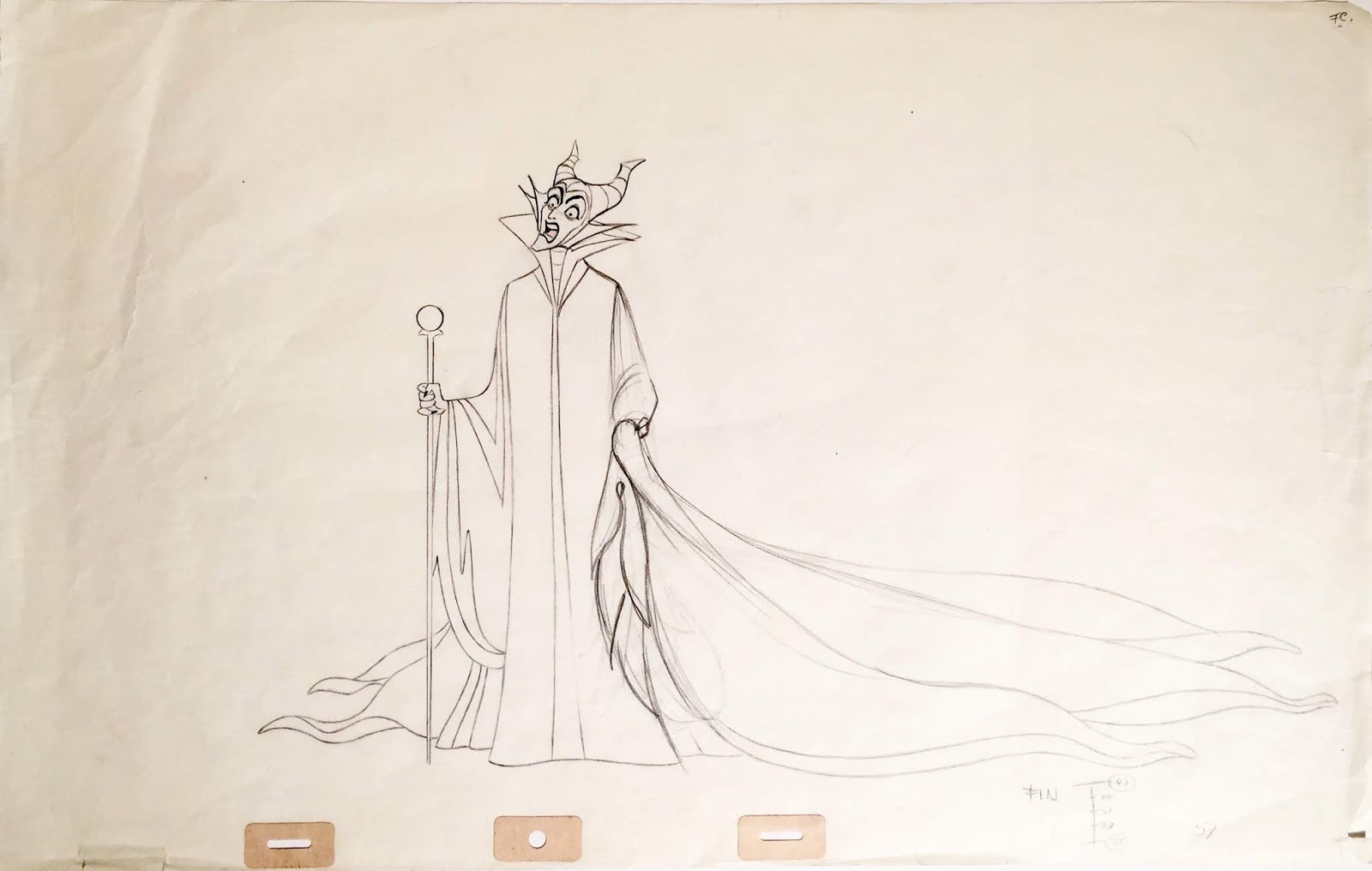
Production Drawing of Maleficent from "Sleeping Beauty," 1959 - "Well Here's Your Precious Princess!"


Full Figure Maleficent drawing; original production drawing of Maleficent in graphite and red pencil from "Sleeping Beauty," 1959; Numbered "51" lower right and with animation ladder lower right; Size - Maleficent 9 x 15 1/2", Sheet 12 1/2 x 19 3/4"


If you ask people to name their favorite Disney Villain, chances are you will one of three answers; The Evil Queen/Witch from "Snow White and the Seven Dwarfs," Cruella DeVil from "101 Dalmatians," or Maleficent from "Sleeping Beauty."  Two of the three, Cruella and Maleficent, were created/drawn by the great animator Marc Davis.  Davis was part of what has been dubbed Disney's Nine Old Men; the core group of animators, some becoming directors, that created the finest animated films ranging from "Snow White and the Seven Dwarfs", 1937 to "The Rescuers", 1977.

The voice of Maleficent was performed by Eleanor Audley.  She had worked for Disney prior by also being the voice for the cold and calculating Lady Tremaine (The Stepmother) in "Cinderella."  If is known that Frank Thomas for Lady Tremaine and Marc Davis for Maleficent, incorporated facials features of Eleanor into both characters.  


Close up of Maleficent production drawing.

The drawing pictured is for sale and is a very rare, eyes and mouth open, full figure, original production drawing of Maleficent.  This drawing is from the very famous scene right after Briar Rose/Princess Aurora pricks her finger on the spinning wheel; fulfilling Maleficent's evil spell!  All three Fairies rush into the room, only to find Maleficent standing alone with her staff.  She tells the Fairies, "You poor simple fools, thinking you could defeat me. Me, the mistress of all evil."  This drawing is from that scene, when her next line is, "Well, here's your precious princess!"  She then pulls her cape away with her left hand, revealing Aurora unconscious on the floor.  The drawing is numbered "51" lower right and has the animation ladder also lower right.  Maleficent is drawn with graphite and red pencil, measures an incredible 9" x 15 1/2," and is on a 12 1/2" x 19 3/4" sheet of three peg hole paper.

To view the scene which this drawing was used to create, click on the short video below:


Monday, January 19, 2015

Gaston drawing from "Beauty and the Beast," 1991 - "And do you know who that little wife will be?"


Original production drawing of Gaston in graphite and blue pencil from "Beauty and the Beast," 1991; Numbered "55" lower right and with animation ladder upper right; Size - Gaston 9 x 6", Sheet 12 1/2 x 17".


Jeffrey Katzenberg, chairman of Walt Disney, was responsible for the creation of the "Beauty and the Beast" as we know it today.  He ordered the film to be made as musical in line with the previous Disney successful film "The Little Mermaid," and Katzenberg oversaw the project down the last details.  In the case of Gaston, the film's villain; he was transformed into a handsome hunter rather than a thin unattractive fop.  Richard White, an American actor and opera singer, was the voice of Gaston and gave the character a wonderful deep bass range which was absolutely perfect!  Andrea Deja was given the task of animating Gaston in a realistic manner; and the role of Gaston was changed to being more of a narcissist, rather than conniving and scheming villain.

Andrea Deja: 
"He (Gaston) was challenging as far as animation assignments are concerned, because Jeffrey Katzenberg insisted that this villain needed to be handsome.  He was right, of course, because the overall theme of the film was: Don't judge a book by its cover.  So, Gaston had to be good looking, but we find out he is not only full of himself, he is also a murderer.  There were scenes where I used live action reference, in other shots I acted out the motion myself. This character was a "toughie" because he had to be handled with realism."


Close up of Gaston drawing.

This drawing is a wonderful original production drawing of Gaston completed in graphite and blue pencil.  His eyes are open and his eyebrows are angled up, with a wonderful full arrogant smile.  You can even see is black hair pony tail!  This drawing is from the wonderful scene where he proposes to Belle, and the line he is saying in this drawing is, "And do you know who that little wife will be?"  Drawings of Gaston are very rare in the open market and this is the first drawing of this character that I have every offered for sale.

To view the scene which this drawing was used to create, click on the short video below:


The film was a huge box office success, with over $424 million in sales worldwide.  "Beauty and the Beast" was nominated for several awards, winning the Golden Globe Award for Best Motion Picture – Musical or Comedy.  It also became the first animated film to be nominated for the Academy Award for Best Picture, as well as nominations for Best Original Score, Best Sound, and three separate nominations for Best Original Song.  The film did win Best Original Score as well as Best Original Song for its title song.  In 2002, "Beauty and the Beast" was deemed "culturally, historically, or aesthetically significant" by the Library of Congress and was selected for preservation in the National Film Registry.  In addition, the film was transformed into an extremely successful Broadway Musical, the first Disney film to make the transition.