Translate

Monday, January 19, 2015

Gaston drawing from "Beauty and the Beast," 1991 - "And do you know who that little wife will be?"


Original production drawing of Gaston in graphite and blue pencil from "Beauty and the Beast," 1991; Numbered "55" lower right and with animation ladder upper right; Size - Gaston 9 x 6", Sheet 12 1/2 x 17".


Jeffrey Katzenberg, chairman of Walt Disney, was responsible for the creation of the "Beauty and the Beast" as we know it today.  He ordered the film to be made as musical in line with the previous Disney successful film "The Little Mermaid," and Katzenberg oversaw the project down the last details.  In the case of Gaston, the film's villain; he was transformed into a handsome hunter rather than a thin unattractive fop.  Richard White, an American actor and opera singer, was the voice of Gaston and gave the character a wonderful deep bass range which was absolutely perfect!  Andrea Deja was given the task of animating Gaston in a realistic manner; and the role of Gaston was changed to being more of a narcissist, rather than conniving and scheming villain.

Andrea Deja: 
"He (Gaston) was challenging as far as animation assignments are concerned, because Jeffrey Katzenberg insisted that this villain needed to be handsome.  He was right, of course, because the overall theme of the film was: Don't judge a book by its cover.  So, Gaston had to be good looking, but we find out he is not only full of himself, he is also a murderer.  There were scenes where I used live action reference, in other shots I acted out the motion myself. This character was a "toughie" because he had to be handled with realism."


Close up of Gaston drawing.

This drawing is a wonderful original production drawing of Gaston completed in graphite and blue pencil.  His eyes are open and his eyebrows are angled up, with a wonderful full arrogant smile.  You can even see is black hair pony tail!  This drawing is from the wonderful scene where he proposes to Belle, and the line he is saying in this drawing is, "And do you know who that little wife will be?"  Drawings of Gaston are very rare in the open market and this is the first drawing of this character that I have every offered for sale.

To view the scene which this drawing was used to create, click on the short video below:


The film was a huge box office success, with over $424 million in sales worldwide.  "Beauty and the Beast" was nominated for several awards, winning the Golden Globe Award for Best Motion Picture – Musical or Comedy.  It also became the first animated film to be nominated for the Academy Award for Best Picture, as well as nominations for Best Original Score, Best Sound, and three separate nominations for Best Original Song.  The film did win Best Original Score as well as Best Original Song for its title song.  In 2002, "Beauty and the Beast" was deemed "culturally, historically, or aesthetically significant" by the Library of Congress and was selected for preservation in the National Film Registry.  In addition, the film was transformed into an extremely successful Broadway Musical, the first Disney film to make the transition.

Monday, January 5, 2015

Production cel of Lady Tremaine (Stepmother) from "Cinderella," 1950


Original hand inked and hand painted production cel of Lady Tremaine (Stepmother) set on a lithographic background from "Cinderella," 1950; Production numbers in ink bottom center "2063-2.5.31" and numbered "48" in ink bottom right; Size - Stepmother 8 x 4 1/4", Cel 10 1/2 x 9 1/4"; Unframed.


"Often, patrons would be horrified or dismayed by the behavior of a villain, but more people actually hated the Stepmother more than any other villain we ever created." - Ollie Johnson and Frank Thomas from "The Disney Villain," 1993

Eleanor Audley (TV and film actress as well as familiar radio and animation voice talent) was filmed while she was dressed and speaking as the Stepmother; and as she performed scenes outlined in the film. Those film reels were used by animator Frank Thomas to convey even more realism to the character. Although the framed images were not directly copied by the animator, they were used as reference for lifelike movements. Eleanor Audley also voiced the Stepmother and her articulation conveyed the fire and raw power of the character. She could be sharp and curt in telling Cinderella what chores to do while lying in bed and slowly stirring her cup of tea, or her voice could be calm are cruel while watching as her daughters viciously destroyed Cinderella's dress.


Stepmother Cel without the background.

Frank Thomas did a phenomenal job of controlling the Stepmother's actions to make sure that they were were not wild and out of control; but rather calculated, cold, and precise. The story of Cinderella presented a situation where a villain lived and interacted with her victim day after day under the same roof. The actions of the Stepmother seemed even more cruel because not only were both she and Cinderella animated in a very realistic fashion, but because of the close proximity the cruelness of the villain could be seen as even more intense by the reactions on Cinderella's face. If all this were not enough, the Stepmother's arsenal of evil was compounded by her two ill mannered daughters Anastasia and Drizella; as well as Lucifer the cat, who delighted in trying to kill Cinderella's mouse friends.


Stepmother Cel with the background, not cropped.

This cel is from the above mentioned very famous scene. Cinderella, wearing the pink dress that was made for her by her mice and bird friends, races down the stairs just as Tremaine and her two daughter are leaving for the Ball. Lady Tremaine realizes that the dress is composed of elements from her daughters Anastasia's and Drizella's wardrobes. When the Stepmother points this out, both Anastasia and Drizella tear Cinderella's dress apart. As Cinderella stands there in the foyer in tattered rags, Lady Tremaine says, "Girls, girls. That's quite enough. Hurry along, now, both of you. I won't have you upsetting yourselves." The Stepmother takes one look at Cinderella before leaving and says simply, "Good night" while she closed the front door as she and her two daughters leave for the Ball.

To view this cel in the film, click on the short video below:


Production cel of Tigger and Rabbit from "Winnie The Pooh and Tigger Too," 1974


Original hand painted production cel of Tigger and Rabbit set on a hand painted non-production watercolor background that matches the scene from "Winnie The Pooh and Tigger Too," 1974; Framed with a gold wood frame, a gold wood fillet, two acid free linen mats, and UV conservation clear glass.


As a child, I loved the Disney character Tigger the most.  I have never met anyone who did not love Tigger, so I know that I am not alone.  My interest in animation has always been focused on Disney and most especially the Villains.  They were always the most interesting characters with some of the best lines in the films.  In the case of the Pooh stories, there were no real Villains; the closest thing would be Rabbit, who was the main antagonist.  However, Tigger was simply fun loving and without question had some the best lines such as "The name's Tigger! T-I-double-guh-ER! That spells Tigger!"  Tigger also has one of the best songs, "The Wonderful Thing about Tiggers."

"The Many Adventures of Winnie The Pooh," 1977 was composed of a series of featurettes Disney produced based upon the Winnie-the-Pooh books by A. A. Milne.  Walt Disney wanted to introduce the public to the Pooh characters slowly over time and the released featurettes include, "Winnie the Pooh and the Honey Tree," 1966, "Winnie the Pooh and the Blustery Day." 1968, and "Winnie the Pooh and Tigger Too," 1974.  For the full length film in 1977, extra material was added and used to link the three featurettes together.  A fourth, shorter featurette was added at the end of the film and was based on the final chapter of "The House at Pooh Corner."

In "Winnie the Pooh and Tigger Too," Rabbit was animated by the great Don Bluth and was voiced by Junius Matthews; a veteran radio actor who also voiced the owl Archimedes in the Disney film "The Sword In The Stone," 1963.  Tigger was animated by one of the greatest Disney animators ever, Milt Kahl and voiced by Paul Winchell.  Winchell was a ventriloquist, actor, and comedian who would later  provide the voice of Gargamel and Dick Dastardly.  Winchell appeared in acting roles on numerous TV shows from the 1950's on through the 1970's.  What many people do not know is that Paul Winchell, who had some medical training and was also an inventor; became the first person to build and patent a mechanical artificial heart which was implantable in the chest cavity.  He was also honored with a star on the Hollywood Walk of Fame for all of his work in television.


Framed Tigger and Rabbit cel.

In this cel Rabbit, frustrated that Tigger had bounced him and in the process made a mess of his garden, had concocted a plan to lose Tigger deep in the forrest.  So Rabbit along with Pooh and Piglet, take Tigger on an exploration on a very foggy morning through the forrest of the Hundred Acre Wood.  Unfortunately Pooh, Piglet, and Rabbit become lost as the ever excited Tigger bounds far ahead deeper into the woods.  Pooh and Piglet find their way out of the woods but Rabbit is hopelessly lost.  Until Tigger bounces him, because as everyone knows, "Tiggers never get lost!"  This is an absolutely wonderful cel taken at the perfect time when Tigger is sitting on top of Rabbit, just after being bounced by him!

To see the cel in the film, just click on the short video below:

Saturday, December 27, 2014

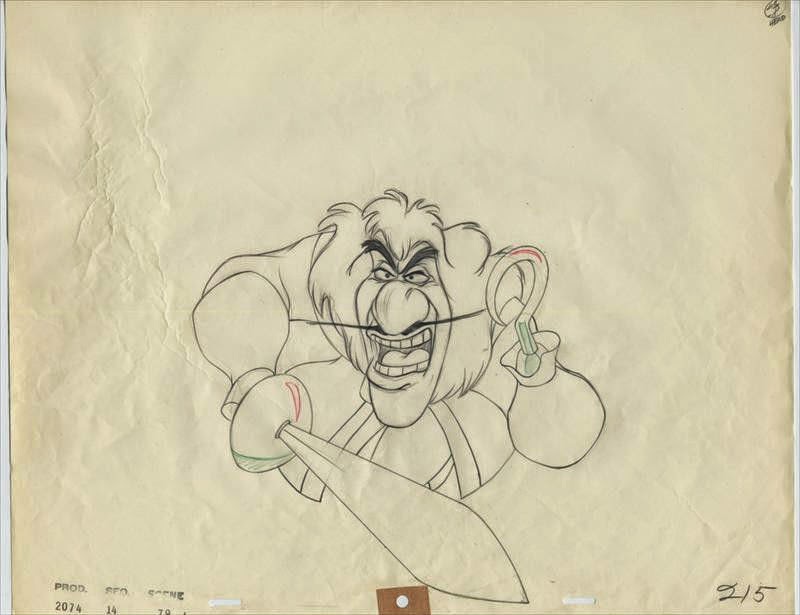
Captain Hook Drawing From "Peter Pan," 1953 - "You’d fly away like a cowardly sparrow."


Original production drawing of Captain Hook from "Peter Pan," 1953; Size - Captain Hook 8 x 8", Sheet 15 1/2 x 12 1/2"; Three peg hole paper stamped PROD 2074 - SEQ 14 - SCENE 79 lower left and numbered in pencil 215 lower right.

To purchase this drawing or to visit the Art Gallery, CLICK HERE

Captain Hook was animated by legendary Frank Thomas and voiced by Hans Conried.  Conried was also the voice of George Darling, which is consistent with the roles of "Peter Pan" for the stage.  I remember seeing Conried acting on "I Love Lucy" where he played an English tutor as well as playing the character Wrongway Feldman on "Gilligan's Island."  His voice was so distinctive and so memorable that he was perfect for the role of Captain Hook; as he had a wonderful way of conveying both the rough gruff pirate role as well and the sly calculating villain.


Frank Thomas's first sketches of Captain Hook were much more menacing than the final product.  Walt Disney felt the character was going to be too frightening for children and so Thomas toned down his drawings.  The result is a wonderful villain and I would say that he is my favorite male villain in the Disney film world.  

This is a fantastic production drawing from the final battle between Captain Hook and Peter Pan aboard the pirate's ship, Jolly Roger.  Captain Hook, armed with is sword and his raised hook pursues Peter Pan into the rigging of the ship, daring Peter to face him.  As he climbs up the rope ladder he says, "Ha ha ha, you wouldn’t dare fight old Hook man to man. You’d fly away like a cowardly sparrow."


Close up of Captain Hook drawing.

Wednesday, December 17, 2014

Mad Hatter and March Hare Cels from "Alice In Wonderland," 1951


Original hand inked and hand painted production cels of The Mad Hatter & The March Hare set on a lithographic copy of a production background from "Alice In Wonderland," 1951; Size - Mad Hatter 6 1/4" x 4 1/4", Cel 9 1/2" x 10 3/4"; March Hare 5 1/4" x 3 3/4", Cel 9 1/2" x 12"; Background 10 1/2" x 16 1/4"

To purchase this cel or to visit the Art Gallery, CLICK HERE

The Mad Hatter and the March Hare are two of the most famous characters in the Walt Disney classic film "Alice In Wonderland," from 1951.  The story is taken from "Alice's Adventures in Wonderland" (commonly shortened to "Alice in Wonderland"), a 1865 novel written by English author Charles Lutwidge Dodgson who wrote under the pseudonym Lewis Carroll.  Disney reworked the story to fit with both a younger audience and a time frame suitable for an animated film (it's run time is 75 minutes).  Kathryn Beaumont was just 10 years old when she was chosen for the voice of Alice and Walt Disney was so impressed by her that she was also chosen to be a model for Alice.  The main villain of the story is the Queen of Hearts, however practically every other character functions as an antagonist towards Alice.


Close up of the two cels.

The Mad Hatter was voiced by Ed Wynn and the voice of the March Hare was provided by Jerry Colonna.  Ed Wynn is one of the most memorable voices in "Alice" and he is a real stand out for the film.  Wynn had a long history in Vaudeville and had developed his giggly, wavering voice in 1921 for the musical review, "The Perfect Fool."  He had several roles at Walt Disney Studios, including his most famous acting role there as Uncle Albert in the film "Mary Poppins," 1964.


Photograph showing The Mad Hatter cel without the background.

The animator Ward Kimball was a tour de force for the film "Alice In Wonderland," and he animated the following: Alice (one scene), the White Rabbit, Tweedledee and Tweedledum, the Cheshire Cat, the Mad Hatter, the March Hare, the Walrus and the Carpenter, the Oysters, and the Dormouse.  Kimball, was a superb draftsman, and he preferred to animate comical characters rather than realistic human figures.  Because of this, "Alice In Wonderland" was the perfect film for him as it was filled with wonderful creatures all acting odd and comical.  Animating came easily to him and he was constantly looking to do things in a different way; which lead Walt Disney to call Kimball a genius in the book "The Story of Walt Disney."


Photograph showing The March Hare cel without the background.

Both of the cels pictured here for sale are from the Mad Tea Party scene and it is one of the most famous scenes in the film, if not all of the Disney films!  The March Hare is from the scene where he uses a spoon and begins to conduct a band of tea pots in the singing of the Unbirthday Song.  The Mad Hatter is also from the Tea Party scene where he pours a cup of tea into a tea pot and then drinks the tea from the tea pot, while saying the following:

Mad Hatter: "Come come my dear, don't you care for tea?"
Alice: "Why, yes. I'm very fond of tea."
March Hare: "If you don't care for tea, you could at least make polite conversation!"

To see the Mad Hatter cel in the film, click on the short clip below:


To see the March Hare cel in the film, click on the short clip below:


Friday, December 12, 2014

Mad Madam Mim In Dragon Form Cel from "The Sword In The Stone," 1963


 A very rare, eyes and mouth open original hand painted production cel of Mad Madam Mim in Dragon form and an original hand painted production cel of fire flames effects from "The Sword In The Stone," 1963.  This cel is from the famous Wizard duel scene with Merlin, when both Mim and Merlin change into various creatures each trying to best the other.  Matted in original Walt Disney Art Corner mat with label sticker verso.

To purchase this cel or to visit the Art Gallery, CLICK HERE

Madam Mim was the villain in the Walt Disney 1963 film "The Sword In The Stone," based on T. H. White's novel by the same name.  Mim was voiced by Martha Wentworth a veteran actress with a long radio history dating back to the 1920's.  She was the voice of several Disney characters in "101 Dalmatians" including Nanny; and Mim was her final credited role.  Madam Mim was animated by two of Disney's greatest animators Milt Kahl (who also designed the character, refining storyboard sketches from animator Bill Peet), and Frank Thomas.  Kahl animated her first appearance in the film, her initial interaction with Arthur; while Frank Thomas oversaw her famous "Wizards' Duel" with Merlin.

Although Mim claims to be more powerful than Merlin, during her opening scene she does only minor tricks.  When Merlin stops her from attacking Arthur she challenges him to a Wizard's duel which involves mutating into various forms in order to best your opponent.  She states that she is "mad for games," and lays out the rules for her duel with Merlin. 

MADAM MIM: "Now, rule one, no mineral or vegetable. Only animal. Rule two, no make-believe things like, pink dragons and stuff. Now, rule three, no disappearing." 
MERLIN: "Rule four, no cheating." 
MADAM MIM: "All right, all right." 

At the very start of the duel, Mim breaks her own rule by disappearing and proves she can not be trusted.  During the battle, Mim's incredible shape shifting abilities almost give her the upper hand against Merlin.  She turned herself into: an alligator, a fox, a hen, an elephant, a tiger, a rattlesnake, and a rhinoceros, all of which were colored pink and finally into an ugly, purple, fire-breathing dragon.  This cel along with a flame overlay cel is from the very begining of the scene when Mim first transforms into a purple dragon and then asks Merlin (knowing that her rule stated no Pink Dragons), "Did I say no purple Dragons?"  BTW: Merlin wins the battle, of course!

Saturday, December 6, 2014

Shere Khan Cel from "The Jungle Book," 1967


A very rare, eyes open original hand painted production cel of Shere Khan from "The Jungle Book," 1967;  With the Disney Seal lower right; Set on a lithographic copy of an original Jungle Book production background;  Framed with two suede acid free mats, a gold and brown wood frame, and UV conservation clear glass.

To purchase this cel or to visit the Art Gallery, CLICK HERE

Shere Khan the tiger is the main antagonist in the 1967 Walt Disney film "The Jungle Book," an adaption of writer Rudyard Kipling's series of stories.  Khan was voiced by George Sanders, a veteran actor with a deep bass voice and a heavy British accent.  The choice of Sanders was perfect for Shere Khan who, in the film, seemed to adopt a British gentleman persona and used British phrases such as "Good show."

Milt Kahl, the great veteran Disney animator, was in charge of bringing Shere Khan to life and so of course Kahl set out on a crash course in tigers.  Kahl said in an interview: " I learned so much about tigers by studying them that I didn't have to rely on any life action crutch."  From Disney animator Andreas Dejas about the animation of Shere Khan, "Great perspective walk, and I love the way the tiger lies down, upper body first, then the rear.  The way he moves those front feet is worth studying alone.  Such great anatomy."


Framed Shere Khan cel

This is an absolutely wonderful cel of Shere Khan and he is almost 10 inches long!  He is seen walking from the left, is large paws slowly moving his massive body forward.  Both eyes are open and he is wearing is ever present frown.  This cel is from when Shere Khan is wondering through the Jungle when he suddenly hears Kaa singing "Trust In Me," and then goes to investigate.  The Walt Disney seal is lower right, he is set on a beautiful lithographic copy of a "Jungle Book" background, and the entire work is custom museum framed.

To see the cel in the film, just click on the short video below: