Translate

Monday, December 11, 2017

Original Production Animation Drawing of Two Cupids from "Fantasia," 1940


Original production animation drawing of two Cupids in red, blue, and graphite pencils, production numbers lower left and numbered 17 lower right; and used during the production of "The Pastoral Symphony" sequence of "Fantasia," 1940, Walt Disney Studios; Size - Two Cupids: 3 3/4 x 5 1/4", Sheet 10 x 12"; Unframed.


"The Pastoral Symphony" segment from Walt Disney's full length feature film "Fantasia," 1940 uses the 6th symphony in F, Op.68 by Ludwig van Beethoven as it's soundtrack. The symphony that Beethoven named "The Pastoral," is said to be one of the few pieces of music he ever wrote that tells a definite story. Beethoven was a great nature lover, and with this symphony he paints a musical picture of a day in the countryside. However, Walt Disney has taken Beethoven's musical score and set it as a backdrop to a fantastical mythological environment.


Close up of the Two Cupids production drawing.

Disney's "The Pastoral Symphony" segment of "Fantasia" utilized expert color styling in order to depict a mythical ancient Greek world of centaurs, pegasi, the Gods of Mount Olympus, fauns, cupids, and other legendary creatures of classical mythology. The segment, directed by Hamilton Luske, Jim Handley, and Ford Beebe; tells the story of mythological creatures gathering for a festival to honor Bacchus, the God of wine.

In the prelude to the Bacchus festival, centaurs and centaurettes begin to congregate. The centaurettes spend time bathing and grooming before the appearance of the centaurs. After a while the centaurs and centaurettes begin to pair off, including the very beautiful Melinda (a blue with blonde haired centaurette with flowers in her tail) and Brudus (a purple and blue centaur with black hair). They are also serenaded by musical instrument carrying cupids, and are soon drawn to one another. Brudus kisses Melinda and they, along with the other creatures, walk hand in hand towards a nearby temple.


Close up of the production number stamp.


Close up of the production number.

Fred Moore, one of Walt Disney's most brilliant animators, supervised the animation of this scene. In this wonderful original production drawing, two Cupids are looking at each other while in flight. The right cupid has a horn in his hand and both are eyes open and smiling! A delightful and beautiful original piece of animation artwork from "Fantasia," 1940.

Friday, December 8, 2017

Original Production Animation Drawing of Melinda The Centaurette From "The Pastoral Symphony" sequence of "Fantasia," 1940


Original production animation drawing of Melinda The Centaurette in red, green, and graphite pencils, production numbers lower left and numbered C-68 lower right; and used during the production of "The Pastoral Symphony" sequence of "Fantasia," 1940, Walt Disney Studios; Size - Melinda: 6 1/4 x 4", Sheet 12 1/2 x 15 1/2"; Unframed.


"The Pastoral Symphony" segment from Walt Disney's full length feature film "Fantasia," 1940 uses the 6th symphony in F, Op.68 by Ludwig van Beethoven as it's soundtrack. The symphony that Beethoven named "The Pastoral," is said to be one of the few pieces of music he ever wrote that tells a definite story. Beethoven was a great nature lover, and with this symphony he paints a musical picture of a day in the countryside. However, Walt Disney has taken Beethoven's musical score and set it as a backdrop to a fantastical mythological environment.


Close up of Melinda The Centaurette production drawing.

Disney's "The Pastoral Symphony" segment of "Fantasia" utilized expert color styling in order to depict a mythical ancient Greek world of centaurs, pegasi, the Gods of Mount Olympus, fauns, cupids, and other legendary creatures of classical mythology. The segment, directed by Hamilton Luske, Jim Handley, and Ford Beebe; tells the story of mythological creatures gathering for a festival to honor Bacchus, the God of wine.

In the prelude to the Bacchus festival, centaurs and centaurettes begin to congregate. The centaurettes spend time bathing and grooming and are always serenaded and tended to by musical instrument carrying cupids. Soon a herd of centaurs arrive onto the scene. After a while the centaurs and centaurettes begin to pair off, and each pair moves away from the others to share a moment alone. They delight in a stolen kiss, dip their hooves into the slow running stream, lay on the grass, or play on a tree swing. Eventually they, along with the other creatures, walk towards a nearby temple.


Close up of the production number.

Fred Moore, one of Walt Disney's most brilliant animators, supervised the animation of this scene. In this wonderful original production drawing of Melinda The Centaurette, drawn with graphite as well as red and green pencils, she is standing full figure with her head tilted down, eyes closed, and her arms are folded behind her. She has bows in her hair and strung flowers around her chest and waist. This is a large and detailed drawing of Melinda, who is one of the main characters from this Fantasia segment. An important and beautiful drawing, that is perfect for any animation art collection!

Original Production Animation Drawing of Brudus The Centaur From "The Pastoral Symphony" sequence of "Fantasia," 1940


Original production animation drawing of Brudus The Centaur in red, green, and graphite pencils numbered 117 lower right, and used during the production of "The Pastoral Symphony" sequence of "Fantasia," 1940, Walt Disney Studios; Size - Brudus: 7 1/2 x 4 3/4", Sheet 12 1/2 x 15 1/2"; Unframed.


"The Pastoral Symphony" segment from Walt Disney's full length feature film "Fantasia," 1940 uses the 6th symphony in F, Op.68 by Ludwig van Beethoven as it's soundtrack. The symphony that Beethoven named "The Pastoral," is said to be one of the few pieces of music he ever wrote that tells a definite story. Beethoven was a great nature lover, and with this symphony he paints a musical picture of a day in the countryside. However, Walt Disney has taken Beethoven's musical score and set it as a backdrop to a fantastical mythological environment.


Close up of the Brudus The Centaur drawing.

Disney's "The Pastoral Symphony" segment of "Fantasia" utilized expert color styling in order to depict a mythical ancient Greek world of centaurs, pegasi, the Gods of Mount Olympus, fauns, cupids, and other legendary creatures of classical mythology. The segment, directed by Hamilton Luske, Jim Handley, and Ford Beebe; tells the story of mythological creatures gathering for a festival to honor Bacchus, the God of wine.

In the prelude to the Bacchus festival, centaurs and centaurettes begin to congregate. The centaurettes spend time bathing and grooming before the appearance of the centaurs. After a while the centaurs and centaurettes begin to pair off, including the very beautiful Melinda (a blue with blonde haired centaurette with flowers in her tail) and Brudus (a purple and blue centaur with black hair). They are also serenaded by musical instrument carrying cupids, and are soon drawn to one another. Brudus kisses Melinda and they, along with the other creatures, walk hand in hand towards a nearby temple. 


Close up of the production number.

Fred Moore, one of Walt Disney's most brilliant animators, supervised the animation of this scene. In this wonderful original production drawing of Brudus, he is standing full figure and smiling. This is a large and detailed drawing of Brutus, who is one of the main characters from this Fantasia segment. An important and beautiful drawing, that is perfect for any animation art collection!

Original Production Animation Drawing of Nubian The Centaurette From "The Pastoral Symphony" sequence of "Fantasia," 1940


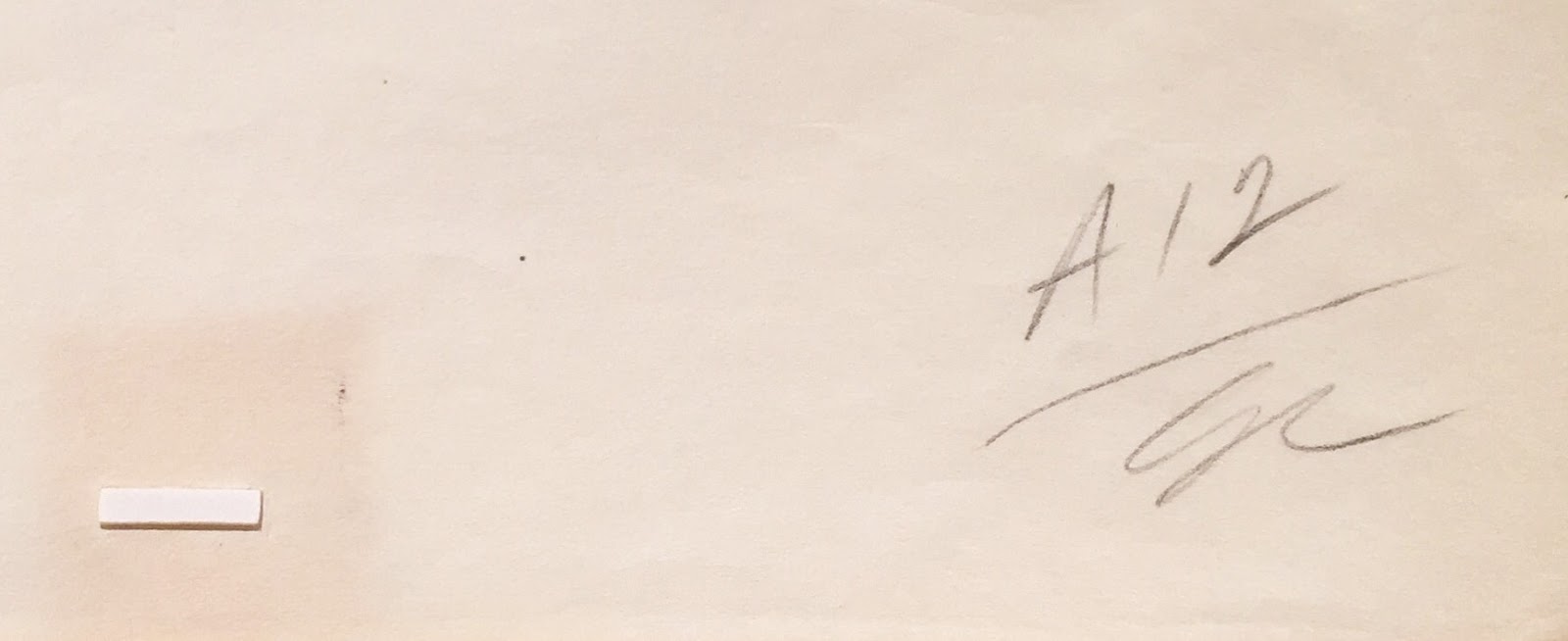
 Original production animation drawing of Nubian The Centaurette in green, blue, and graphite pencils, production numbers lower left and numbered A12 lower right; and used during the production of "The Pastoral Symphony" sequence of "Fantasia," 1940, Walt Disney Studios; Size - Nubian: 7 1/2 x 3 1/4", Sheet 12 1/2 x 15 1/2"; Unframed.


"The Pastoral Symphony" segment from Walt Disney's full length feature film "Fantasia," 1940 uses the 6th symphony in F, Op.68 by Ludwig van Beethoven as it's soundtrack. The symphony that Beethoven named "The Pastoral," is said to be one of the few pieces of music he ever wrote that tells a definite story. Beethoven was a great nature lover, and with this symphony he paints a musical picture of a day in the countryside. However, Walt Disney has taken Beethoven's musical score and set it as a backdrop to a fantastical mythological environment.

Disney's "The Pastoral Symphony" segment of "Fantasia" utilized expert color styling in order to depict a mythical ancient Greek world of centaurs, pegasi, the Gods of Mount Olympus, fauns, cupids, and other legendary creatures of classical mythology. The segment, directed by Hamilton Luske, Jim Handley, and Ford Beebe; tells the story of mythological creatures gathering for a festival to honor Bacchus, the God of wine.


Close up of Nubian The Centaurette production drawing.

In the prelude to the Bacchus festival, centaurs and centaurettes begin to congregate. The centaurettes spend time bathing and grooming and are always serenaded and tended to by musical instrument carrying cupids. Soon a herd of centaurs arrive onto the scene. After a while the centaurs and centaurettes begin to pair off, and each pair moves away from the others to share a moment alone. They delight in a stolen kiss, dip their hooves into the slow running stream, lay on the grass, or play on a tree swing. Eventually they, along with the other creatures, walk towards a nearby temple.


Close up of the production stamp.


Close up of the production number.

Fred Moore, one of Walt Disney's most brilliant animators, supervised the animation of this scene. This is a extremely rare original production drawing of Nubian The Centaurette. A pair of Nubians (one carrying a jug of wine and the other carrying a fan) appear on either side of Bacchus (The God of Wine) as he enters the wine festival while riding on a small black Unicorn. Drawings of the Nubian Centaurettes are very rare. Their composition of half African female and half Zebra have resulted in their being seen as racial stereotypes; and Disney has censored their scenes for all "Fantasia" re-releases.

This is a full figure, eyes open, and large drawing of the Nubian. She is carrying a fan attached to a long pole and is accomplished in graphite and green pencils. An exceptionally detailed and rare drawing from the Walt Disney masterpiece of 1940, "Fantasia." An great and important piece of animation art history, perfect for any collection!

Original Production Cel of José Carioca from "The Three Caballeros," 1944


Original hand painted and hand inked production animation cel of José Carioca from "The Three Caballeros," 1944, Walt Disney Studios; Set over a Courvoisier air brush background; With Courvoisier Galleries label; Size - José Carioca: 4 3/4 x 4", Image 7 x 7 1/2", Mat 15 x 14"; Matted with Courvoisier stamp and calligraphy titled mat.

"The Three Caballeros," 1944 is an animated musical film produced by Walt Disney Productions which premiered in Mexico City on December 21, 1944, in the United States on February 3, 1945, and in the United Kingdom in March. The film focuses on a fantastic adventure which occurs through  Latin America and is combination of both live-action and animation.

The film stars Donald Duck, who is joined by his old friend José Carioca, the cigar-smoking parrot from "Saludos Amigos," 1942 (representing Brazil); and later becomes friends with the pistol-packing rooster, Panchito Pistoles (representing Mexico). The film is laid out as a series of individual segments that are connected by Donald Duck opening birthday gifts from his Latin American friends. Several Latin American stars appear in the film including; singers Aurora Miranda (sister of Carmen Miranda) and Dora Luz, and the singer and dancer Carmen Molina.


Calligraphy titled mat.


Courvoisier stamp.

José Carioca is a green Brazilian tropical parrot from Rio de Janeiro. His design is based on a parrot that Walt Disney spotted during his trip to Brazil. José is suave, cool, fun, and a ladies man. He was animated by Vladimir Tytla, Ward Kimball, Ollie Johnston, and Fred Moore. He was voiced by the Brazilian actor José Oliveira.


Matted original production animation cel of José Carioca..


Courvoisier Galleries label.

This is the finest original production cel of José Carioca that I have ever owned. An absolutely perfect eyes and mouth open image of José leaning on his umbrella, while smoking his cigar. It really just dosen't get any better, and a true highlight of any animation art collection!

Original Production Animation Cel of Ariel from "The Little Mermaid," 1989


Original hand painted production animation cel of Ariel on a lithographic background from "The Little Mermaid," 1989, Walt Disney Studios; Disney seal lower right; Size - Ariel: 3 3/4 x 6 1/4", Image 9 1/4 x 15 1/2"; Unframed.

To purchase this cel or to visit the Art Gallery, CLICK HERE!

Ariel: "Who - who are you?"
Jetsam: "Don't be scared."
Flotsam: "We represent someone who can help you."
Jetsam: "Someone who could make all your dreams come true."

"The Little Mermaid," is an American animated musical fantasy film and the 28th film in the Walt Disney Animated Classics series. It was produced by Walt Disney Feature Animation and released by Walt Disney Pictures to theaters on November 17, 1989. The film was based on the Danish fairy tale of the same name by Hans Christian Andersen, which tells the story of a beautiful mermaid princess who dreams of becoming human. The film was written, directed, and produced by Ron Clements and John Musker; with music by Alan Menken and Howard Ashman. The voice cast includes: Jodi Benson, Christopher Daniel Barnes, Pat Carroll, Samuel E. Wright, Jason Marin, Kenneth Mars, Buddy Hackett, and René Auberjonois.


Original production animation cel of Ariel the Little Mermaid.


Close up of the original production animation cel of Ariel the Little Mermaid.

There was more money and resources dedicated by the Walt Disney Studios to "The Little Mermaid" than any other Disney animated film in decades. Aside from its main animation facility in Glendale, California; Disney opened a satellite feature animation facility in Lake Buena Vista, Florida that was within the Disney-MGM Studios Theme Park at Walt Disney World. Their first projects were to produce an entire Roger Rabbit cartoon short, "Roller Coaster Rabbit," and to contribute ink and paint support to "The Little Mermaid." Another first for Disney films of recent years, was the filming of live actors and actresses for motion reference material for the animators. Broadway actress Jodi Benson (who was predominantly a stage actress when she was cast) was chosen to play Ariel, and Sherri Lynn Stoner, a former member of Los Angeles' Groundlings improvisation comedy group, acted out Ariel's key scenes.


Close up of The Walt Disney Company seal.

The Little Mermaid's supervising animators included Glen Keane and Mark Henn on Ariel, Duncan Marjoribanks on Sebastian, Andreas Deja on King Triton, and Ruben Aquino on Ursula. Originally, Keane had been asked to work on Ursula, as he had established a reputation for drawing large powerful figures, such as the bear in "The Fox and the Hound," 1981 and Professor Ratigan in "The Great Mouse Detective," 1986. Keane however, was assigned as one of the two lead artists on the petite Ariel and oversaw the "Part of Your World" musical number. He jokingly stated that his wife looks exactly like Ariel "without the fins." The character's body type and personality were based upon that of Alyssa Milano, who was starring on TV's "Who's the Boss?". The effect of Ariel's hair underwater was based on footage of Sally Ride when she was in space; and scenes of Sherri Lynn Stoner in a swimming pool were used in animating Ariel's swimming. A challenge in animating Ariel were the colors required to show her in various changing environments, both under the sea and on land. By the end of the film, the animators required a total of 32-color models; not including costume changes. The sea-green color of her fin was a hue specially mixed by the Disney paint lab, and the color was named "Ariel" after the character.

This is an absolutely beautiful cel of Ariel, The Little Mermaid! She is full figure, both eyes are open, and her green tail fin is clearly visible. This cel is from the scene after her father, King Triton, destroys a statue of Prince Eric that was inside her secret grotto. After Triton, Sebastian, and Flounder leave; Ariel is lying at the bottom of the grotto when Ursula's two eels Flotsam and Jetsam appear. The dialog for the scene is below:

Flotsam: "Poor child."
Jetsam: "Poor, sweet child."
Flotsam: "She has a very serious problem."
Jetsam: "If only there were something we could do."
Flotsam: "But there is something."
Ariel: "Who - who are you?"
Jetsam: "Don't be scared."
Flotsam: "We represent someone who can help you."
Jetsam: "Someone who could make all your dreams come true."
Flotsam and Jetsam: "Just imagine -"
Jetsam: "You and your prince -"
Flotsam and Jetsam: "Together, forever. . . . "

Original Production Animation Cel of Jessica Rabbit from "Who Framed Roger Rabbit?," 1988


Original hand painted production animation cel of Jessica Rabbit from "Who Framed Roger Rabbit?," 1988, Walt Disney Studios; Set on a custom painted background; Walt Disney Company Seal lower left and with original Walt Disney Company Disneyana Certificate; Size - Jessica Rabbit: 7 3/4 x 4 3/4", Image 10 x 13", Double Matted 17 x 20"; Matted.

To purchase this cel or to visit the Art Gallery, CLICK HERE!

"I'm not bad, I'm just drawn that way." - Jessica Rabbit

"Who Framed Roger Rabbit," 1988 is a Walt Disney live-action/animated fantasy featured film that was released on June 22, 1988. The film was produced by Frank Marshall and Robert Watts, written by Jeffrey Price and Peter S. Seaman, and is based on Gary K. Wolf's 1981 novel "Who Censored Roger Rabbit?" The film stars Bob Hoskins, Christopher Lloyd, Charles Fleischer, Stubby Kaye, and Joanne Cassidy. Combining live-action with animation, the story follows a private detective, Eddie Valiant, who must exonerate "Toon" Roger Rabbit who is accused of murdering a wealthy businessman. The film was a blockbuster and critical success wining three Academy Awards and a Special Achievement Award. The film grossed $329,803,958 in 1988, and at the time of release was the twentieth highest grossing film of all time. In 2016 the film was selected for preservation in the United States National Film Registry by the Library of Congress as being "culturally, historically, or aesthetically significant."

Walt Disney Pictures purchased the film rights for "Who Framed Roger Rabbit" in 1981 and in 1985 the project was revamped by Michael Eisner, the new CEO of Disney. Eisner brought in executive producer Steven Spielberg and his production company Amblin Entertainment. Spielberg convinced Warner Bros., Fleischer Studios, King Features Syndicate, Felix the Cat Productions, Turner Entertainment, and Universal Pictures/Walter Lantz Productions to "lend" their character to appear in the film; although many had stipulations were added about how the characters could be portrayed. For example Disney's Donald Duck and Warner Bros. Daffy Duck would appear as equally-talented dueling pianists; and Mickey Mouse and Bugs Bunny would also share equal time for their first ever animated screen scene together. Spielberg's negotiations contributed to audience admiration for the film because of a large number of famous animated characters appearing together for the first time. The cast of characters, combined with brilliant animation that was integrated with seamless live action, made the film a visual masterpiece!


Jessica Rabbit original production animation cel.


Close up of the Jessica Rabbit original production animation cel without the background.


Close up of The Walt Disney Company Seal.


Original Walt Disney Company Disneyana Certificate.

The breakout character of the film was Jessica Rabbit, Roger's beautiful and seductive "Toon" wife. Jessica was animated by Walt Disney supervising animator Richard Williams and by James Baxter; and Kathleen Turner provided the voice of the character, but was uncredited in the film. Amy Irving supplied Jessica's singing voice and Betsy Brantley was the live actress stand-in. Jessica Rabbit was an incredible mix of cartoon and realism that merged in the creation of a modern femme fatale, who captivated male viewers all over the world!


Matted Jessica Rabbit original production animation cel.

Jessica Rabbit first appears in the film when she performs the song "Why Don't You Do Right?" at the "Ink and Paint Club." The name of the club is derived from the Ink and Paint Department of Walt Disney Animation Studios, where all the inking and painting of animation cels occurs. This is a fantastic original production animation cel of Jessica, and is a stunning large and close up image showing off her bust, narrow waist, and hips. A spectacular image that is perfect for any Walt Disney animation art collection!