Translate

Wednesday, December 19, 2018

Original Production Animation Drawing of The White Rabbit from "Alice In Wonderland," 1951


Original production animation drawing of the White Rabbit in graphite, brown, and blue pencils from "Alice In Wonderland," 1951, Walt Disney Studios; Numbered 101A lower right; Size - White Rabbit, Horn, & Shadow: 5 1/4 x 5", Sheet 10 x 12"; Unframed.

To purchase this drawing or to visit the Art Gallery, CLICK HERE!

"I'm overdue. I'm really in a stew. No time to say goodbye, hello! I'm late. I'm late I'm late!" - White Rabbit

"Alice's Adventures in Wonderland" (commonly shortened to "Alice in Wonderland"), is a 1865 novel written by English author Charles Lutwidge Dodgson who wrote under the pseudonym Lewis Carroll. Disney reworked the story to fit with both a younger audience and a time frame suitable for an animated film (it's run time is only 75 minutes).

Kathryn Beaumont, who was born in London England, was just 10 years old when she was chosen for the voice of Alice. Walt Disney personally cast Beaumont after seeing her in the film "On an Island with You," in which the child actress had a small role. Disney was so impressed by her that she was also chosen to be the model for Alice, and would also go on to provide the voice for Wendy in "Peter Pan," 1953. Beaumont has also reprised her voice acting role as Alice in two episodes of the animated series, Disney's "House of Mouse," and as both Alice and Wendy in the video game "Kingdom Hearts." She did not retire as the voice of Alice and Wendy until 2005, when her role for these two characters was taken over by Hynden Walch.

The White Rabbit is one of the most well known and referenced fictional characters in Lewis Carroll's book "Alice's Adventures in Wonderland." He first appears in chapter one, wearing a waistcoat, and muttering "Oh dear! Oh dear! I shall be too late!" Alice follows him down the rabbit hole into Wonderland, and encounters him again when he mistakes her for his housemaid Mary Ann. Soon Alice becomes trapped in his house after growing too large. The Rabbit shows up again in the last few chapters of the book, as a herald-like servant of the King and Queen of Hearts.

However, in Walt Disney's animated version of the story, the White Rabbit seems to be the most logical of all the Wonderland characters; and appears throughout the film to lead Alice along further into Wonderland. The Rabbit is perhaps most famous for the little song he sang at the beginning of the film - "I'm late! I'm late! For a very important date! No time to say hello, goodbye! I'm late! I'm late! I'm late!" He was animated by various animators including: Fred Moore, Ward Kimball, Judge Whitaker, and Wolfgang Reitherman. But most of the work was done by either Fred Moore or Ward Kimball; both of whom were wonderful at bringing this type of exaggerated character to life.


Close up of the White Rabbit original production animation drawing.

The White Rabbit was voiced by American Radio and Voice Actor Bill Thompson. Thompson had an extraordinary career spanning from the 1930's until he passed away in 1971. He worked extensively for Walt Disney Studios, and can be heard in many shorts and features, often in either dialect parts or a variation of his famous and masterful Wimple/Droopy voice. For "Alice In Wonderland," he was the voice of both the White Rabbit and the Dodo. He went on to be the voice of Mr. Smee (and the other pirates) in "Peter Pan," and also King Hubert in "Sleeping Beauty."

This is an adorable original production animation drawing of the White Rabbit. He is full figure, wearing his eyeglasses, eyes and mouth open (with his tongue sticking out), has his horn in is right paw, and he is running forward; obviously because he is late. An absolutely beautiful piece of vintage Walt Disney animation art and a great addition to any animation collection!

Original Production Animation Drawing of The White Rabbit from "Alice In Wonderland," 1951


Original production animation drawing of the White Rabbit in graphite pencil from "Alice In Wonderland," 1951, Walt Disney Studios; Numbered 9 lower right; Size - White Rabbit: 1 x 1 1/2", Sheet 10 x 12"; Unframed.

To purchase this drawing or to visit the Art Gallery, CLICK HERE!

"I'm overdue. I'm really in a stew. No time to say goodbye, hello! I'm late. I'm late I'm late!" - White Rabbit

"Alice's Adventures in Wonderland" (commonly shortened to "Alice in Wonderland"), is a 1865 novel written by English author Charles Lutwidge Dodgson who wrote under the pseudonym Lewis Carroll. Disney reworked the story to fit with both a younger audience and a time frame suitable for an animated film (it's run time is only 75 minutes).

Kathryn Beaumont, who was born in London England, was just 10 years old when she was chosen for the voice of Alice. Walt Disney personally cast Beaumont after seeing her in the film "On an Island with You," in which the child actress had a small role. Disney was so impressed by her that she was also chosen to be the model for Alice, and would also go on to provide the voice for Wendy in "Peter Pan," 1953. Beaumont has also reprised her voice acting role as Alice in two episodes of the animated series, Disney's "House of Mouse," and as both Alice and Wendy in the video game "Kingdom Hearts." She did not retire as the voice of Alice and Wendy until 2005, when her role for these two characters was taken over by Hynden Walch.

The White Rabbit is one of the most well known and referenced fictional characters in Lewis Carroll's book "Alice's Adventures in Wonderland." He first appears in chapter one, wearing a waistcoat, and muttering "Oh dear! Oh dear! I shall be too late!" Alice follows him down the rabbit hole into Wonderland, and encounters him again when he mistakes her for his housemaid Mary Ann. Soon Alice becomes trapped in his house after growing too large. The Rabbit shows up again in the last few chapters of the book, as a herald-like servant of the King and Queen of Hearts.

However, in Walt Disney's animated version of the story, the White Rabbit seems to be the most logical of all the Wonderland characters; and appears throughout the film to lead Alice along further into Wonderland. The Rabbit is perhaps most famous for the little song he sang at the beginning of the film - "I'm late! I'm late! For a very important date! No time to say hello, goodbye! I'm late! I'm late! I'm late!" He was animated by various animators including: Fred Moore, Ward Kimball, Judge Whitaker, and Wolfgang Reitherman. But most of the work was done by either Fred Moore or Ward Kimball; both of whom were wonderful at bringing this type of exaggerated character to life.


Close up of the White Rabbit original production animation drawing.

The White Rabbit was voiced by American Radio and Voice Actor Bill Thompson. Thompson had an extraordinary career spanning from the 1930's until he passed away in 1971. He worked extensively for Walt Disney Studios, and can be heard in many shorts and features, often in either dialect parts or a variation of his famous and masterful Wimple/Droopy voice. For "Alice In Wonderland," he was the voice of both the White Rabbit and the Dodo. He went on to be the voice of Mr. Smee (and the other pirates) in "Peter Pan," and also King Hubert in "Sleeping Beauty."

This is an adorable original production animation drawing of the White Rabbit. He is full figure, eyes and mouth open, has his horn in is right paw, and he is walking forward. An absolutely beautiful piece of vintage Walt Disney animation art and a great addition to any animation collection!

Original Production Animation Drawing of The Mad Hatter from "Alice In Wonderland," 1951


Original production animation drawing of the Mad Hatter in graphite pencil from "Alice In Wonderland," 1951, Walt Disney Studios; Numbered 15 lower right; Size - Mad Hatter: 7 x 2 3/4", Sheet 10 x 12"; Unframed.

To purchase this drawing or to visit the Art Gallery, CLICK HERE!

"Alice's Adventures in Wonderland" (commonly shortened to "Alice in Wonderland"), is a 1865 novel written by English author Charles Lutwidge Dodgson who wrote under the pseudonym Lewis Carroll. Disney reworked the story to fit with both a younger audience and a time frame suitable for an animated film (it's run time is only 75 minutes).

Kathryn Beaumont, who was born in London England, was just 10 years old when she was chosen for the voice of Alice. Walt Disney personally cast Beaumont after seeing her in the film "On an Island with You," in which the child actress had a small role. Disney was so impressed by her that she was also chosen to be the model for Alice, and would also go on to provide the voice for Wendy in "Peter Pan," 1953. Beaumont has also reprised her voice acting role as Alice in two episodes of the animated series, Disney's "House of Mouse," and as both Alice and Wendy in the video game "Kingdom Hearts." She did not retire as the voice of Alice and Wendy until 2005, when her role for these two characters was taken over by Hynden Walch.


Close up of the original production animation drawing of the Mad Hatter.

The Mad Hatter was voiced by Ed Wynn and he is one of the most memorable voices in "Alice" and a real stand out for the film. Wynn had a long history in Vaudeville and had developed his giggly, wavering voice in 1921 for the musical review, "The Perfect Fool." He had several roles at Walt Disney Studios, including his most famous acting role there as Uncle Albert in the film "Mary Poppins," in 1964.

The animator Ward Kimball was a tour de force for the film "Alice In Wonderland," and he animated the following: Alice (one scene), the White Rabbit, Tweedledee and Tweedledum, the Cheshire Cat, the Mad Hatter, the March Hare, the Walrus and the Carpenter, the Oysters, and the Dormouse. Kimball, was a superb draftsman, and he preferred to animate comical characters rather than realistic human figures. Because of this, "Alice In Wonderland" was the perfect film for him as it was filled with wonderful creatures all acting odd and comical. Animating came easily to him and he was constantly looking to do things in a different way; which lead Walt Disney to call Kimball a genius in the book "The Story of Walt Disney."

This is a large and beautifully rendered drawing of the Mad Hatter. He is full figure, eyes and mouth open, and he walking with his hand on his hip. A great action oriented image of one of the stand out characters from the film. This is an absolutely beautiful piece of vintage Walt Disney animation art and a great addition to any animation collection!

Original Production Animation Drawing of Alice from "Alice In Wonderland," 1951


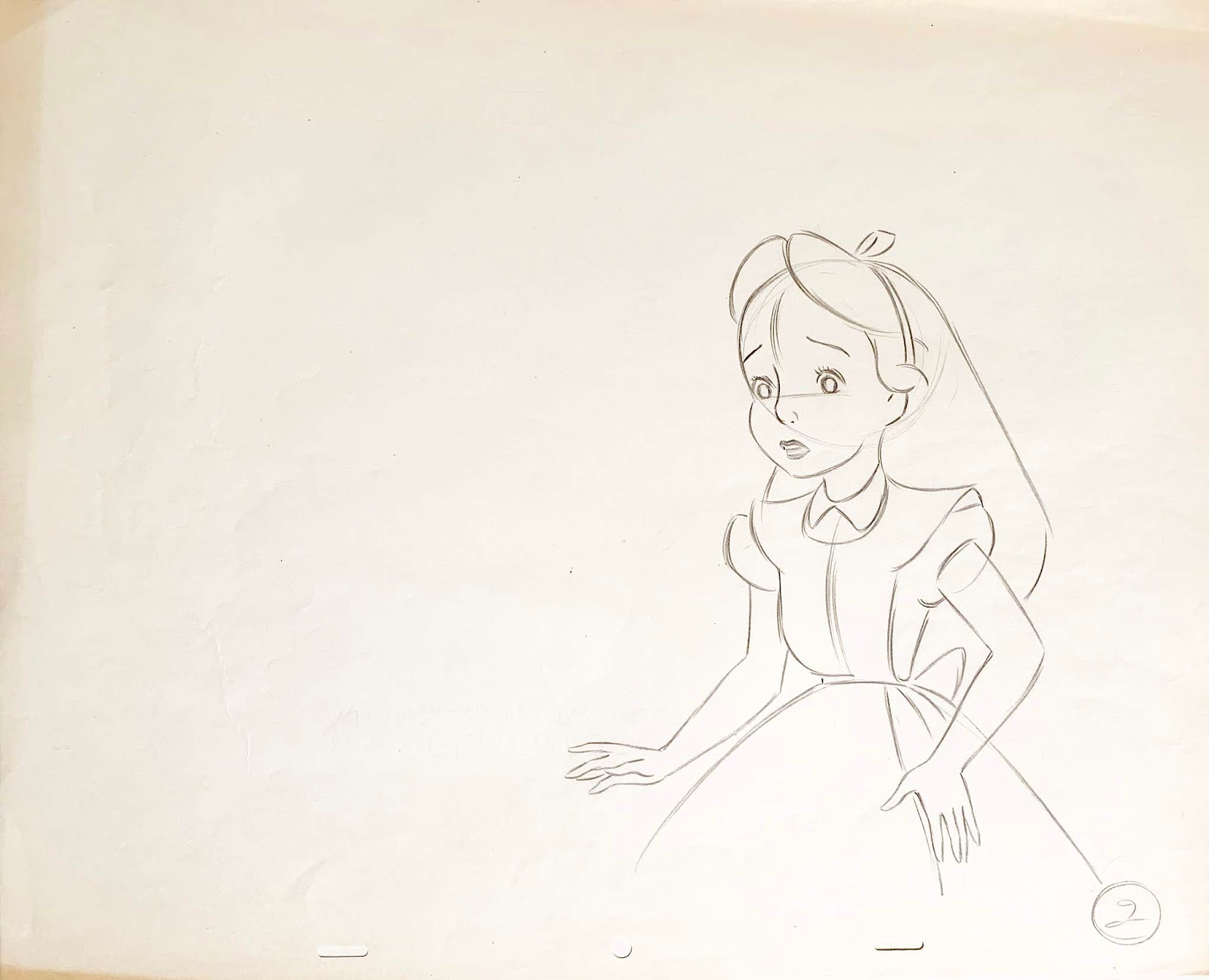
Original production animation drawing of Alice in graphite pencil from "Alice In Wonderland," 1951, Walt Disney Studios; Numbered 2 in pencil lower right; Size - Alice: 8 1/2 x 6 3/4", Sheet 12 1/2 x 15 1/2"; Unframed.

To purchase this drawing or to visit the Art Gallery, CLICK HERE!

"Curiouser and curiouser." - Alice

"Alice's Adventures in Wonderland" (commonly shortened to "Alice in Wonderland"), is a 1865 novel written by English author Charles Lutwidge Dodgson who wrote under the pseudonym Lewis Carroll. Disney reworked the story to fit with both a younger audience and a time frame suitable for an animated film (it's run time is only 75 minutes).

Kathryn Beaumont, who was born in London England, was just 10 years old when she was chosen for the voice of Alice. Walt Disney personally cast Beaumont after seeing her in the film "On an Island with You," in which the child actress had a small role. Disney was so impressed by her that she was also chosen to be the model for Alice, and would also go on to provide the voice for Wendy in "Peter Pan," 1953. Beaumont has also reprised her voice acting role as Alice in two episodes of the animated series, Disney's "House of Mouse," and as both Alice and Wendy in the video game "Kingdom Hearts." She did not retire as the voice of Alice and Wendy until 2005, when her role for these two characters was taken over by Hynden Walch.

Initial design for the character of Alice was accomplished by Mary Blair during the storyboard phase and also by Les Clark. Alice was animated by Ollie Johnston, Don Lusk, and Marc Davis who animated her for the tea party scene.


Close up of the original production animation drawing of Alice.

This is a large and beautifully rendered drawing of Alice. Her mouth and eyes are open, her arms are by her side, and she is looking surprised. This is an absolutely beautiful piece of vintage Walt Disney animation art and a great addition to any animation collection!

Original Production Animation Drawing of Alice from "Alice In Wonderland," 1951


Original production animation drawing of Alice in graphite and brown pencils from "Alice In Wonderland," 1951, Walt Disney Studios; Numbered 97 in pencil lower right; Size - Alice: 8 1/4 x 7 1/2", Sheet 12 1/2 x 15 1/2"; Unframed.

To purchase this drawing or to visit the Art Gallery, CLICK HERE!

"But that's just the trouble with me. I give myself very good advice... but I very seldom follow it." - Alice

"Alice's Adventures in Wonderland" (commonly shortened to "Alice in Wonderland"), is a 1865 novel written by English author Charles Lutwidge Dodgson who wrote under the pseudonym Lewis Carroll. Disney reworked the story to fit with both a younger audience and a time frame suitable for an animated film (it's run time is only 75 minutes).

Kathryn Beaumont, who was born in London England, was just 10 years old when she was chosen for the voice of Alice. Walt Disney personally cast Beaumont after seeing her in the film "On an Island with You," in which the child actress had a small role. Disney was so impressed by her that she was also chosen to be the model for Alice, and would also go on to provide the voice for Wendy in "Peter Pan," 1953. Beaumont has also reprised her voice acting role as Alice in two episodes of the animated series, Disney's "House of Mouse," and as both Alice and Wendy in the video game "Kingdom Hearts." She did not retire as the voice of Alice and Wendy until 2005, when her role for these two characters was taken over by Hynden Walch.

Initial design for the character of Alice was accomplished by Mary Blair during the storyboard phase and also by Les Clark. Alice was animated by Ollie Johnston, Don Lusk, and Marc Davis who animated her for the tea party scene.


Close up of the original production animation drawing of Alice.

This is a large and beautifully rendered drawing of Alice from the "Very Good Advise" song sequence. Walt Disney animator Milt Kahl supervised the animation of Alice for this singing scene, which occurs at the end of the Tugley Wood sequence. The song was composed by Oliver Wallace, with lyrics by Paul J. Smith, and is sung by Alice after she becomes hopelessly lost in Wonderland and fears that she will never find her way home. In this drawing Alice's mouth is open, she is seated with her hands clasped in her lap, and small tears (rendered in brown pencil) are seen forming in the corners of her eyes. This is an absolutely beautiful piece of vintage Walt Disney animation art and a great addition to any animation collection!

Original Production Animation Drawing of The March Hare from "Alice In Wonderland," 1951


Original production animation drawing of the March Hare in graphite and red pencils from "Alice In Wonderland," 1951, Walt Disney Studios; Animation ladder and numbered 24 in pencil lower right; Size - March Hare & Hammer: 10 x 8", Sheet 12 1/2 x 15 1/2"; Unframed.

To purchase this drawing or to visit the Art Gallery, CLICK HERE!

"There's only one way to stop a mad watch!" - March Hare

"Alice's Adventures in Wonderland" (commonly shortened to "Alice in Wonderland"), is a 1865 novel written by English author Charles Lutwidge Dodgson who wrote under the pseudonym Lewis Carroll. Disney reworked the story to fit with both a younger audience and a time frame suitable for an animated film (it's run time is only 75 minutes).

Kathryn Beaumont, who was born in London England, was just 10 years old when she was chosen for the voice of Alice. Walt Disney personally cast Beaumont after seeing her in the film "On an Island with You," in which the child actress had a small role. Disney was so impressed by her that she was also chosen to be the model for Alice, and would also go on to provide the voice for Wendy in "Peter Pan," 1953. Beaumont has also reprised her voice acting role as Alice in two episodes of the animated series, Disney's "House of Mouse," and as both Alice and Wendy in the video game "Kingdom Hearts." She did not retire as the voice of Alice and Wendy until 2005, when her role for these two characters was taken over by Hynden Walch.


Close up of the original production animation drawing of the March Hare.

The animator Ward Kimball was a tour de force for the film "Alice In Wonderland," and he animated the following: Alice (one scene), the White Rabbit, Tweedledee and Tweedledum, the Cheshire Cat, the Mad Hatter, the March Hare, the Walrus and the Carpenter, the Oysters, and the Dormouse. Kimball, was a superb draftsman, and he preferred to animate comical characters rather than realistic human figures. Because of this, "Alice In Wonderland" was the perfect film for him as it was filled with wonderful creatures all acting odd and comical. Animating came easily to him and he was constantly looking to do things in a different way; which lead Walt Disney to call Kimball a genius in the book "The Story of Walt Disney."

The March Hare's appearance and mannerisms were modeled after his original voice actor, Jerry Colonna. Gerardo Luigi "Jerry" Colonna was an American comedian, singer, songwriter, and trombonist; who is best remembered as the zaniest of Bob Hope's sidekicks in his popular radio shows and films of the 1940s and 1950s.

This drawing is from the mad tea party scene when the March Hare asks for the time, and suddenly the White Rabbit appears shouting that he has no time because he is late! The Mad Hatter says, "No wonder you are late,  why this clock is exactly two days slow." The Hatter then begins a series of crazy fixes to the watch by taking off it's backing, looking at the gears and causing damage by adding salt, picking out the watch wheels and springs with a fork, spreading butter and pouring tea into the watch, pressing two sugar spoons into the open back, and spreading jam into the open back. Finally the March Hare, holding up a pot, asked the Hatter "Mustard?" And the Hatter replies, "Mustard! Yes, mu- MUSTARD? Don't let's be silly! Lemon, that's different..." Suddenly the watch begins to ring and move and jump about the table, throwing out springs, gears, and screws. The Hatter and March Hare realize that the pocket watch has gone mad, and the Hare says "There's only one way to stop a mad watch!" He pulls out a large hammer and smashes the watch. This is a large and spectacular drawing of the March Hare holding his hammer in a very dynamic action oriented pose; an absolutely beautiful piece of vintage Walt Disney animation art and a great addition to any animation collection!

Original Production Animation Drawing of The Mad Hatter from "Alice In Wonderland," 1951


Original production animation drawing of the Mad Hatter in graphite pencil from "Alice In Wonderland," 1951, Walt Disney Studios; Numbered 171 lower right; Size - Mad Hatter: 7 x 4 1/4", Sheet 10 x 12"; Unframed.

To purchase this drawing or to visit the Art Gallery, CLICK HERE!

"And uh, and now my dear, hehe, uh... you were saying that you would like to sea.. uh...? You were seeking some information some kind... hehe!" -Mad Hatter

"Alice's Adventures in Wonderland" (commonly shortened to "Alice in Wonderland"), is a 1865 novel written by English author Charles Lutwidge Dodgson who wrote under the pseudonym Lewis Carroll. Disney reworked the story to fit with both a younger audience and a time frame suitable for an animated film (it's run time is only 75 minutes).

Kathryn Beaumont, who was born in London England, was just 10 years old when she was chosen for the voice of Alice. Walt Disney personally cast Beaumont after seeing her in the film "On an Island with You," in which the child actress had a small role. Disney was so impressed by her that she was also chosen to be the model for Alice, and would also go on to provide the voice for Wendy in "Peter Pan," 1953. Beaumont has also reprised her voice acting role as Alice in two episodes of the animated series, Disney's "House of Mouse," and as both Alice and Wendy in the video game "Kingdom Hearts." She did not retire as the voice of Alice and Wendy until 2005, when her role for these two characters was taken over by Hynden Walch.


Close up of the original production animation drawing of the Mad Hatter.

The Mad Hatter was voiced by Ed Wynn and he is one of the most memorable voices in "Alice" and a real stand out for the film. Wynn had a long history in Vaudeville and had developed his giggly, wavering voice in 1921 for the musical review, "The Perfect Fool." He had several roles at Walt Disney Studios, including his most famous acting role there as Uncle Albert in the film "Mary Poppins," in 1964.

The animator Ward Kimball was a tour de force for the film "Alice In Wonderland," and he animated the following: Alice (one scene), the White Rabbit, Tweedledee and Tweedledum, the Cheshire Cat, the Mad Hatter, the March Hare, the Walrus and the Carpenter, the Oysters, and the Dormouse. Kimball, was a superb draftsman, and he preferred to animate comical characters rather than realistic human figures. Because of this, "Alice In Wonderland" was the perfect film for him as it was filled with wonderful creatures all acting odd and comical. Animating came easily to him and he was constantly looking to do things in a different way; which lead Walt Disney to call Kimball a genius in the book "The Story of Walt Disney."

This is a large and beautifully rendered drawing of the Mad Hatter. The drawing is from the very famous mad tea party scene. The Hatter is speaking with Alice as he takes his tea cup saucer, dips it into his cup of tea, and takes a bite out of it; as if it's a tea biscuit. He says "And uh, and now my dear, hehe, uh... you were saying that you would like to sea.. uh...? You were seeking some information some kind... hehe!" A great action oriented image of one of the stand out characters from the film. This is an absolutely beautiful piece of vintage Walt Disney animation art and a great addition to any animation collection!