Translate

Thursday, March 26, 2020

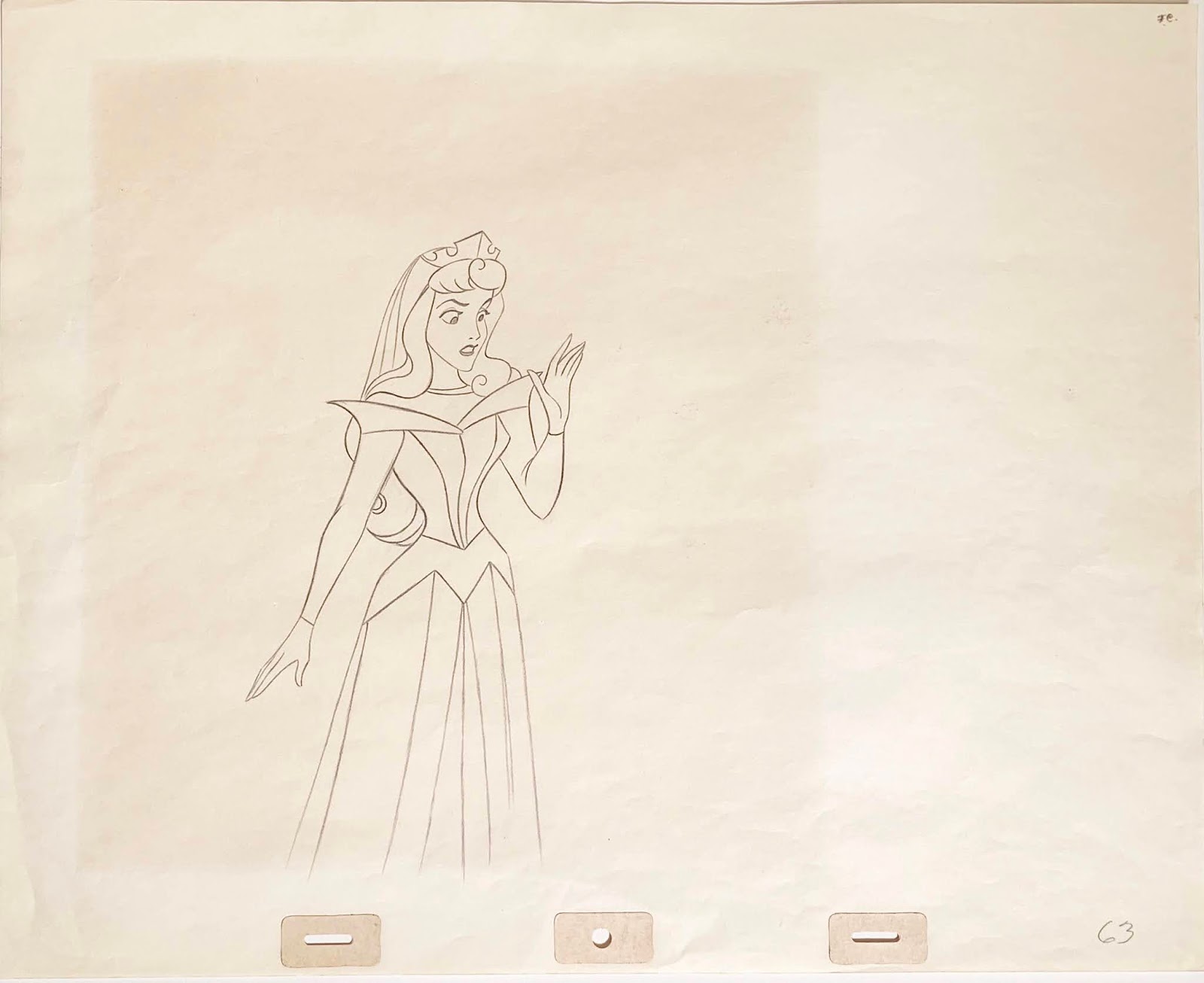
Original Production Animation Drawing of Princess Aurora from "Sleeping Beauty," 1959


Original production animation drawing of Princess Aurora in graphite pencil from "Sleeping Beauty," 1959, Walt Disney Studios; Numbered 63 in pencil lower right; Size - Princess Aurora 8 1/4 x 4", Sheet 12 1/2 x 15 1/2"; Unframed.

To purchase this drawing or to visit the Art Gallery, CLICK HERE!

"Don't touch anything!" - Flora, Fauna, and Merryweather

"Sleeping Beauty" is a Walt Disney animated full length feature film and was based on "The Sleeping Beauty" by Charles Perrault and "Little Briar Rose" by The Brothers Grimm. The film was the sixteenth in the Walt Disney Animated Classics series, and it was released to theaters on January 29, 1959 by Buena Vista Distribution. This was to be the last Disney adaptation of a fairy tale for many years, both because of its initial mixed critical reception, and because of it's under performance at the box office. The Walt Disney studio did not return to the fairy tale genre until 30 years later, with the release of "The Little Mermaid" in 1989. "Sleeping Beauty" was directed by Les Clark, Eric Larson, and Wolfgang Reitherman, under the supervision of Clyde Geronimi. The story was written by Joe Rinaldi, Winston Hibler, Bill Peet, Ted Sears, Ralph Wright, and Milt Banta. The film's musical score and songs, featuring the Graunke Symphony Orchestra, was under the direction of George Bruns. Arrangements and/or adaptations were derived from numbers from the 1890 "Sleeping Beauty Ballet" by Pyotr Ilyich Tchaikovsky. In addition, Igor Stravinsky's music compositions were also adapted into the film. "Sleeping Beauty" was the first animated film to be photographed in the Super Technirama 70 widescreen process, as well as the second full-length animated feature film to be filmed in anamorphic widescreen; following "Lady and the Tramp" four years earlier. In select first-run engagements, the film was presented in Super Technirama 70 and 6-channel stereophonic sound.

"Sleeping Beauty" introduced two characters that would become universal favorites; Maleficent and Princess Aurora. Aurora, along with Snow White and Cinderella would be forever immortalized in the public's view as the three greatest Disney Princesses. The original design for Aurora was developed by Tom Oreb, who based the character on the famed Hollywood actress Audrey Hepburn; known for her thin frame and a very graceful demeanor. Marc Davis, the head animator for Aurora, would continue the development of the character by morphing her general appearance and the clothing of the heroine. The fine tuning of the character continued so that she could be combined with the very angular forms present in the Eyvind Earle hand painted backgrounds.

As with other Disney films, an actress was hired as a live-action model (as a guide for the animators) for Princess Aurora. Helene Stanley, who was also the model for Cinderella in 1950, became the model for the heroine. It is interesting to note that prior to marrying Marc Davis in 1956, Alice (Davis) designed some of costumes worn by Stanley in her acting role as Aurora.


Close up of the Princess Aurora original production drawing.

In 1952, the professional opera singer Mary Costa, after meeting people at a party with her future husband director Frank Tashlin, auditioned for the part of Disney's Princess Aurora. Walt Disney called her personally within hours of the audition to inform her that the part was hers. The success of the film "Sleeping Beauty," owes a chuck of those accolades to the voice of Mary Costa. Her songs were some of the most beautiful ever sung by a Disney Princess. In November 1999 Mary Costa received the Disney Legends Award, and her hand prints are now a permanent part of the Disney Legends Plaza at the entrance to Walt Disney Studios.

The majority of the film does not have Aurora on the big screen, but rather her disguised form Briar Rose. Even though Princess Aurora is one of the most loved of all the Disney Princesses, she has least amount of screen time of any prior Princess; only 18 minutes to be exact and during those 18 minutes she only has 18 lines.

This drawing is an absolutely wonderful work from one of the most important key scenes in the film, when Maleficent has enchanted Princess Aurora. Slowly Aurora climbs a stone staircase leading into an empty room, where suddenly a spinning wheel appears. Soon Maleficent is heard urging Aurora to touch the spindle (thereby fulfilling the evil curse) as the three good fairies are quickly flying to save her; all the while shouting "Don't touch anything!" This is a very rare original production drawing of Princess Aurora wearing her crown. She has both eyes open and her hand is just in front of her, soon to be outstretched towards the spindle of the spinning wheel.

Original Production Animation Drawing of Thumper from "Bambi," 1942


Original production animation drawing in red and graphite pencils of Thumper from "Bambi," 1942, Walt Disney Studios; Production numbers in pencil lower sheet edge; Numbered C-105 in pencil lower right; Size - Thumper: 2 x 1 1/2", Sheet: 10 x 12"; Unframed.

 To purchase this drawing or to visit the Art Gallery, CLICK HERE!

"Whatcha gonna call him?" - Thumper
"Well, I think I'll call him Bambi." - Bambi's Mother
"Yep, I guess that'll do all right." - Thumper

"Bambi," 1942 is a full length animated film by Walt Disney Studios and based on the book "Bambi, A Life in the Woods" by Austrian author Felix Salten. The film was released by RKO Radio Pictures on August 13, 1942. "Bambi" received three Academy Award nominations: Best Sound (Sam Slyfield), Best Song (for "Love Is a Song" sung by Donald Novis), and Best Original Music Score. In June 2008, the American Film Institute presented a list of its "10 Top 10" (the best ten films in each of ten classic American film genres) and "Bambi" placed third in the animation category. In December 2011, "Bambi" was added to the National Film Registry of the Library of Congress.


Close up of the original production animation drawing of Thumper.

The story centers on Bambi, a white-tailed deer, his parents (the Great Prince of the forest and his unnamed mother), his animal friends Thumper (a pink-nosed rabbit), Flower (a skunk), and his childhood friend and future mate, a doe named Faline. Walt Disney wanted all of the animals to be more realistic and expressive than those in "Snow White". He had Rico LeBrun, a wildlife animal painter, come into the Disney Studios to lecture to the animators on the structure and movement of animals. The animators went on excursions to the Los Angeles Zoo and Walt Disney set up a small zoo at the Disney Animation Studio with animals such as rabbits, ducks, owls, skunks, and a pair of fawns aptly named Bambi and Faline; so that the artists could see first-hand animal movement. Animator Marc Davis created the final design of Bambi by incorporating LeBurn's realistic study of deer anatomy but exaggerating the character's face by making his proportions baby-like; including a short snout and big expressive eyes.

"Bambi" was Walt Disney's favorite film he ever made, and it is not too surprising given his love of nature films. The special effects, particularly the water, and the lush hand painted backgrounds create a wonderful environment that allows the viewer to be totally immersed into the film. Combined with a great story of friendship and complete success in the creation of characters; the film is able to provide amazing feelings of both happiness and sadness, as the viewer watches Bambi grows up from fawn to deer.

Thumper (whose name is derived from his common habit of thumping his hind left foot), is Bambi's first and closest friend. He is a young, comical rabbit; and a well-known inhabitant of the forest who takes Bambi "under his wings" and teaches him the ways of the forest. Thumper was voiced by 4-year-old Peter Behn. With Behn's voice added to the film; suddenly the vivacious bunny character was expanded from him having only minor role, to playing a much more significant lead. In addition, the film underwent a major plot change with the theme of friendship front and center. The character of Thumper was initially designed by animator Marc Davis and was brought to life by several animators including: Frank Thomas, Milt Kahl, Eric Larson, and Ollie Johnston. Thumper was not only voiced by Peter Behn (young Thumper), but by Tim Davis (young adult Thumper) and Sam Edwards (adult Thumper).

This is a wonderful original production animation drawing of Thumper from Walt Disney's favorite full length feature animated film "Bambi." This is a great full figure, eyes and mouth open drawing of Thumper rendered in red and graphite pencils. A beautiful and rare piece of vintage Walt Disney original production animation that is perfect for any art collection!

Original Production Animation Cel of Shere Khan from "The Jungle Book," 1967


Original hand painted production animation cel of Shere Khan from "The Jungle Book," 1967, Walt Disney Studios; Set on a lithographic background; Numbered 99 in ink and Walt Disney seal lower right; Size - Shere Khan: 7 3/4 x 4 1/2", Image 9 1/2 x 15"; Unframed.


"The Jungle Book," 1967 was the nineteenth animated feature film produced by Walt Disney Productions and inspired by Rudyard Kipling's book of the same name. The film was directed by Wolfgang Reitherman, it was to be the last film that was worked on by Walt Disney, as he passed away during its production. The film follows Mowgli, a feral child raised in the Indian jungle by wolves, as he encounters Bagheera the panther and Baloo the bear; who try and convince him to leave the jungle before the villainous tiger Shere Khan finds him. Voice actors include: Phil Harris, Sebastian Cabot, George Sanders and Louis Prima; as well as Disney regulars such as Sterling Holloway, J. Pat O'Malley, Verna Felton, and the director's son, Bruce Reitherman, as the voice of Mowgli.

Shere Khan, a Bengal tiger, is the main antagonist in the 1967 Walt Disney film "The Jungle Book;" an adaption of writer Rudyard Kipling's series of stories. Khan was voiced by George Sanders, a veteran actor with a deep bass voice and a heavy British accent. According to Frank Thomas and Ollie Johnston from "The Disney Villain":

"The perfect choice for the voice was George Sanders, the complete cynic, who added the element of boredom. With this voice, we could imagine a tiger who would kill without concern or effort. Sanders was asked if he would like a drawing of Shere Khan as a souvenir, to which he responded, "I suppose so." Asked further if he would like Walt to autograph it, he replied, "How utterly absurb. Why would I want his signature? He might want mine, I created the character."

Milt Kahl, the great veteran Disney animator, was in charge of bringing Shere Khan to life and so of course Kahl set out on a crash course in tigers. Kahl said in an interview:  I learned so much about tigers by studying them that I didn't have to rely on any life action crutch." From Disney animator Andreas Dejas about the animation of Shere Khan, "Great perspective walk, and I love the way the tiger lies down, upper body first, then the rear.  The way he moves those front feet is worth studying alone. Such great anatomy."


Original production animation cel of Shere Khan without the background.


Close up of the Walt Disney seal and the production number.

The next two paragraphs are excepts from "The Disney Villain," by Frank Thomas and Ollie Johnston:

"It is not often that true villains as unique as Kaa and Shere Khan confront each other. In "The Jungle Book" the meeting was not a a victim-villain relationship because thy had nearly equal strengths. It was more a game of "keep away." Kaa will not admit that he has Mowgli hypnotized high in the tree as the tiger suspects. In a cold but polite manner Shere Khan tries to intimidate the crafty Kaa by suggesting, 'I thought you might be entertaining someone up there in your coils.'"

"The tiger is almost unbeatable, but he is unable to find out if Mowgli is really up in the tree. Any other character would have been terrified by the treatment Kaa is receiving, yet the snake continues to be evasive. He is a slippery antagonist, withstanding threats and humiliation in order to keep Mowgli for himself. It is an entertaining standoff for these two powerful predators, but it is Mowgli who eventually wins the day."

This is a wonderful original production animation cel of the evil tiger, Shere Khan. He is shown in a three quarters portrait image with his yellow eyes open, and a wicked mouth open smile. It really does not get better, just a spectacular full cel of the villainous tiger that is perfect for any animation art collection!

Original Production Animation Cel of Cruella De Vil from "One Hundred and One Dalmatians," 1961


Original hand painted production animation cel of Cruella De Vil from "One Hundred and One Dalmatians," 1961, Walt Disney Studios; Set on a lithographic background; Size - Cruella De Vil: 6 1/4" x 8 1/2", Image 8 3/4" x 12 1/2"; Unframed.


"Cruella De Vil, Cruella De Vil, if she doesn't scare you; no evil thing will." - Roger

"One Hundred and One Dalmatians" ("101 Dalmatians"), is a 1961 full length animated feature film by Walt Disney Productions. It was adapted from Dodie Smith's 1956 novel of the same name. It stars Rod Taylor as the voice of Pongo and Cate Bauer as the voice of Perdita; with Betty Lou Gerson as the voice of the evil and villainous Cruella de Vil. The animation of all the characters from the film was quite extraordinary.

The film "Sleeping Beauty," 1959 was very expensive to make and it took a huge financial loss at the box-office; as a result, the Disney animation studio was considering closing. During the production of "Sleeping Beauty," Walt Disney told animator Eric Larson: "I don't think we can continue, it's too expensive." Because Disney's entire company was based on animation, he was looking for a way to continue with animation, and at the same time significantly reduce costs.

The animator Ub Iwerks had been experimenting with Xerox photography to aid in animation process. By 1959 he had modified a Xerox camera to transfer the drawings by the animators, directly onto animation cels. The process would preserve the spontaneity of the penciled drawings but eliminate the inking process, thus saving time and money. However, the limitation was that the camera was unable to deviate from a black scratchy outline, and the resulting cels lacked the fine lavish quality of hand inking.

Cruella along with Maleficent are two of the most favorite of all the Disney villains, and they were both animated by Marc Davis. The character of Cruella De Vil was created by Dodie Smith for his novel "101 Dalmatians" in 1956, but it was Davis's visual interpretation that the world remembers. Although some of Cruella's traits were based in the novel, Davis along with Bill Peat, morphed the character by making her razor thin and exaggerating her oversized coat onto her thin frame. The long cigarette holder was modeled on one Davis used himself. Inspiration was also drawn from Hollywood legends Tallulah Bankhead, Bette Davis, and Rosalind Russell. Movement, according to Davis, was consistent "like someone you wouldn't like," and another inspiration was based on "one woman I knew who was just a monster. She was tall and thin and talked constantly - you never knew what she was saying, but you couldn't get a word in edgewise."

The voice of Cruella was provided by Betty Lou Gerson. She had worked for Disney prior as the narrator for Cinderella, but her voice talent as Cruella De Vil is her tour de force! The highly pitched phrase "Anita Darling!" is completely iconic and has become part of Disney pop culture.


Cruella De Vil original production animation cel without the background.

This is absolutely perfect cel of Cruella De Vil; she has her left hand on her hip, her eyes and mouth are open, she is wearing her classic mink coat, and holding her cigarette with holder in her right hand. A great addition to any Disney Villain or animation art collection!

Wednesday, March 25, 2020

Original Production Animation Cel of Alice and a Flamingo from "Alice In Wonderland," 1951


Original hand inked and hand painted production animation cel of Alice and a Flamingo set on a lithographic background from "Alice In Wonderland," 1951, Walt Disney Studios; With original Art Corner Certificate sticker; Size - Alice & Flamingo: 7 1/4 x 8", Image 8 1/4 x 9 1/4"; Unframed.

To purchase this cel or to visit the Art Gallery, CLICK HERE!

"Do you play croquet?" - Queen of Hearts
"Why, yes, your majesty." - Alice
"Then let the game begin!" - Queen of Hearts

"Alice's Adventures in Wonderland" (commonly shortened to "Alice in Wonderland"), is a 1865 novel written by English author Charles Lutwidge Dodgson who wrote under the pseudonym Lewis Carroll. Disney reworked the story to fit with both a younger audience and a time frame suitable for an animated film (it's run time is only 75 minutes).

Kathryn Beaumont, who was born in London England, was just 10 years old when she was chosen for the voice of Alice. Walt Disney personally cast Beaumont after seeing her in the film "On an Island with You," in which the child actress had a small role. Disney was so impressed by her that she was also chosen to be the model for Alice, and would also go on to provide the voice for Wendy in "Peter Pan," 1953. Beaumont has also reprised her voice acting role as Alice in two episodes of the animated series, Disney's "House of Mouse," and as both Alice and Wendy in the video game "Kingdom Hearts." She did not retire as the voice of Alice and Wendy until 2005, when her role for these two characters was taken over by Hynden Walch.

Initial design for the character of Alice was accomplished by Mary Blair during the storyboard phase and also by Les Clark. Alice was animated by Ollie Johnston, Don Lusk, and Marc Davis who animated her for the tea party scene.


Close up of the original production animation cel of Alice and a Flamingo.


Original Art Corner Certificate sticker.

This is a very action oriented original production animation cel of Alice and a Flamingo. When the Queen of Hearts first meets Alice, she challenges her to a game of croquet. In the Wonderland version, the croquet mallets, balls and hoops are composed of Flamingos, Hedgehogs, and Playing Cards. In this cel, Alice is trying to get the Pink Flamingo to act like a croquet mallet. Alice is eyes open with a surprised look, and the Flamingo is eyes open and has a coy smile. This is an absolutely beautiful piece of vintage Walt Disney animation art and a great addition to any animation collection!

Original Production Animation Drawing of Mickey Mouse and Minnie Mouse from "Ye Olden Days," 1933


Original production animation drawing of Mickey Mouse and Minnie Mouse from "Ye Olden Days," 1933, Walt Disney Studios; Graphite pencil on peg hole paper; Numbered 40 in pencil lower right; Size - Mickey and Minnie Mouse: 5 3/4 x 3 1/4", Sheet 9 1/2 x 12"; Unframed; Unframed.


"Ye Olden Days" (released April 8, 1933) is a black and white Walt Disney Company animated short film directed by Bert Gillett and animated by Johnny Cannon, Les Clark, Art Babbitt, and Norm Ferguson. It stars Pinto Colvig as the voice of Dippy Dawg (later renamed Goofy), Walt Disney as the voice of Mickey Mouse, and Marcellite Garner as the voice of Minnie Mouse.


Close up of the Mickey Mouse and Minnie Mouse original production animation drawing.

The story of "Ye Olden Days" takes place in the middle ages. Mickey Mouse, the singing and lute playing wandering Minstrel, rides on his donkey and stumbles upon a castle. Inside the castle, the King is holding court, and Princess Minnie and Prince Dippy Dawg (later named Goofy) are about to marry. But Princess Minnie has second thoughts and ends up slapping the Prince. The King, angry over the incident, says to his Guards "Lock her in the attic!" Palace Guards lock Princess Minnie and her hand servant, Clarabelle Cow, in the attic. Minnie and Clarabelle start to cry and are overheard by Mickey, who is outside the tower window.

Mickey makes his way into the attic, through a window, and tells Minnie that he will save her. Mickey grabs Minnie and glides down a rope that was made from Clarabelle's clothing. As the pair make their way down the rope past a window, the King spots them and has them immediately arrested. The King threatens to chop Mickey's head off, but Minnie begs her father for forgiveness; because she has fallen in love with Mickey. 

The King then announces, "Clear the hall, we'll have a duel. The Prince shall battle this young fool!" Mickey and the Prince prepare themselves and their faithful steads for the duel. The duel begins between Mickey and the Prince and, when they both fall off their animals, a duel erupts between Mickey's donkey and the Prince's horse. Mickey's donkey bites the horse's bottom making him whinny and bump into a wall. A portrait of the King falls onto the horse, rendering him unconscious.  Minstrel Mickey eventually wins his duel with the Prince, who ends up falling out of a window. Then the Princess kisses her father the King, and goes off with Mickey. Both Mickey and Minnie sit atop Mickey's donkey as the crowd carries them outside. The film ends as Mickey and Minnie share a kiss, shielded behind a hand held fan.

This is an absolutely wonderful drawing of Mickey Mouse and Minnie Mouse from the black and white animated short "Ye Olden Days," 1933. It is rare to have more than one character on a single sheet of animation paper, and this is a fantastic image. This drawing is from the end of the film, when  Mickey is helping Princess Minnie up onto Mickey's donkey. Both characters are full figure, eyes open, and they are looking at each other and smiling. A great and rare image from one of the early Walt Disney cartoon shorts.

#Goofy #MickeyMouse #YeOldenDays #PintoColvig #Disney #WaltDisney #untitledartgallery 
#animation #cel #animationcel #animationdrawing #productiondrawing #productioncel #DippyDawg 
#Mickey #MinnieMouse #Minnie #JohnnyCannon #LesClark #ArtBabbitt #NormFerguson #BertGillett 
#PrincessMinnie #MarcelliteGarner

Original Production Animation Drawing of Mickey Mouse from "Ye Olden Days," 1933


Original production animation drawing of Mickey Mouse sitting on his Donkey and twenty Crowd Members from "Ye Olden Days," 1933, Walt Disney Studios; Graphite pencil on peg hole paper; Numbered 11A lower right; Size - Mickey Mouse, Donkey, & Crowd: 7 3/4 x 2 3/4", Sheet 9 1/2 x 11"; Unframed.


"Ye Olden Days" (released April 8, 1933) is a black and white Walt Disney Company animated short film directed by Bert Gillett and animated by Johnny Cannon, Les Clark, Art Babbitt, and Norm Ferguson. It stars Pinto Colvig as the voice of Dippy Dawg (later renamed Goofy), Walt Disney as the voice of Mickey Mouse, and Marcellite Garner as the voice of Minnie Mouse.

The story of "Ye Olden Days" takes place in the middle ages. Mickey Mouse, the singing and lute playing wandering Minstrel, rides on his donkey and stumbles upon a castle. Inside the castle, the King is holding court, and Princess Minnie and Prince Dippy Dawg (later named Goofy) are about to marry. But Princess Minnie has second thoughts and ends up slapping the Prince. The King, angry over the incident, says to his Guards "Lock her in the attic!" Palace Guards lock Princess Minnie and her hand servant, Clarabelle Cow, in the attic. Minnie and Clarabelle start to cry and are overheard by Mickey, who is outside the tower window.

Mickey makes his way into the attic, through a window, and tells Minnie that he will save her. Mickey grabs Minnie and glides down a rope that was made from Clarabelle's clothing. As the pair make their way down the rope past a window, the King spots them and has them immediately arrested. The King threatens to chop Mickey's head off, but Minnie begs her father for forgiveness; because she has fallen in love with Mickey. 

The King then announces, "Clear the hall, we'll have a duel. The Prince shall battle this young fool!" Mickey and the Prince prepare themselves and their faithful steads for the duel. The duel begins between Mickey and the Prince and, when they both fall off their animals, a duel erupts between Mickey's donkey and the Prince's horse. Mickey's donkey bites the horse's bottom making him whinny and bump into a wall. A portrait of the King falls onto the horse, rendering him unconscious.  Minstrel Mickey eventually wins his duel with the Prince, who ends up falling out of a window. Then the Princess kisses her father the King, and goes off with Mickey. Both Mickey and Minnie sit atop Mickey's donkey as the crowd carries them outside. The film ends as Mickey and Minnie share a kiss, shielded behind a hand held fan.

This is an absolutely wonderful drawing of Mickey Mouse on his donkey surrounded by a crowd from the black and white animated short "Ye Olden Days," 1933. It is rare to have more than one character on a single sheet of animation paper, and this is a fantastic image of twenty members of the cheering crowd that has hoisted Mickey Mouse sitting on his donkey into the air. This drawing is from the end of the film, when  Mickey is being hailed a hero by a cheering crowd. A great and rare image from one of the early Walt Disney cartoon shorts.