Translate

Monday, August 25, 2014

Recently Sold Animation Art


Original hand painted production animation cel of Lucky, Patch, and a Puppy from "101 Dalmatians," 1961


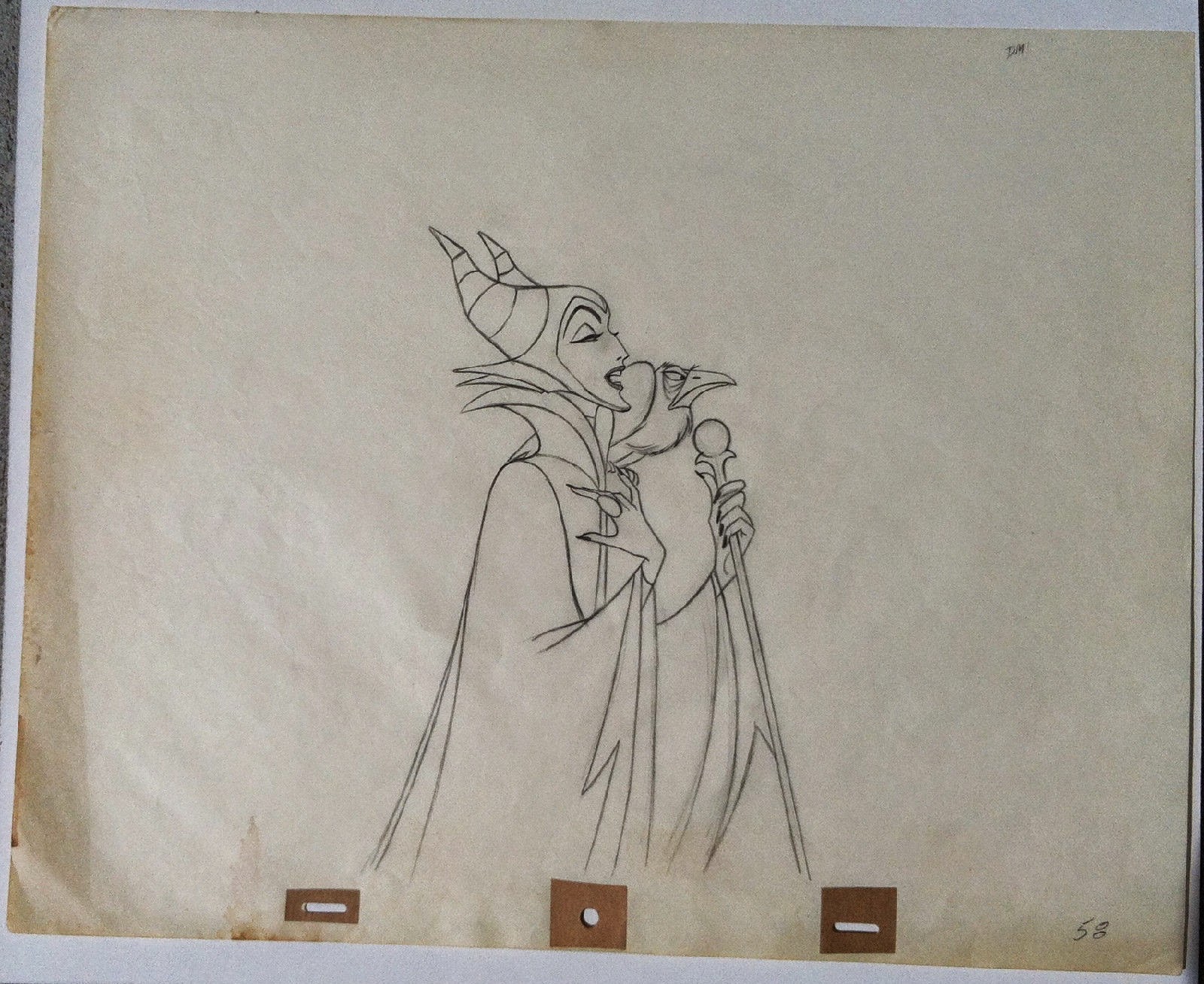
Original production animation drawing of Maleficent and Diablo from "Sleeping Beauty," 1959


Original Production cels of Kanga, Roo, and Eeyore from "Winnie the Pooh and the Honey Tree," 1966

Tuesday, August 19, 2014

Wicked Stepmother Production Cel - Lady Tremaine from "Cinderella," 1950


Original hand inked and hand painted production cel of Lady Tremaine set on a lithographic copy of the matching key production background from "Cinderella," 1950

To purchase this cel or to visit the Art Gallery, CLICK HERE

"Often, patrons would be horrified or dismayed by the behavior of a villain, but more people actually hated the Stepmother more than any other villain we ever created." - Ollie Johnson and Frank Thomas from "The Disney Villain," 1993

When I first saw Cinderella, I was one those kids that hated the Stepmother and was very frightened of what she might be capable of doing to poor Cinderella.  The Stepmother (or Lady Tremaine) was a tour de force for the Disney animation team and her motivation was simple.  All of her actions were the result of jealously for Cinderella's beauty and a desire to climb a social ladder by marrying off one her daughters to Prince Charming.  Lady Tremaine did not harm Cinderella physically but rather punish and abuse her psychologically, with an ultimate goal of gaining even more power and status.

Eleanor Audley (TV and film actress as well as familiar radio and animation voice talent) was filmed while she was dressed and speaking as the Stepmother; and as she performed scenes outlined in the film.  Those film reels were used by animator Frank Thomas to convey even more realism to the character.  Although the framed images were not directly copied by the animator, they were used as reference for lifelike movements.  Eleanor Audley also voiced the Stepmother and her articulation conveyed the fire and raw power of the character.  She could be sharp and curt in telling Cinderella what chores to do while lying in bed and slowly stirring her cup of tea, or her voice could be calm are cruel while watching as her daughters viciously destroyed Cinderella's dress.   As Cinderella stands there in the foyer in tattered rags, Lady Tremaine simply says, "good night" while she and her two daughters close the front door to leave for the ball.

Frank Thomas did a phenomenal job of controlling the Stepmother's actions to make sure that they were were not wild and out of control; but rather calculated, cold, and precise.  The story of Cinderella presented a situation where a villain lived and interacted with her victim day after day under the same roof.  The actions of the Stepmother seemed even more cruel because not only were both she and Cinderella animated in a very realistic fashion, but because of the close proximity the cruelness of the villain could be seen as even more intense by the reactions on Cinderella's face.  If all this were not enough, the Stepmother's arsenal of evil was compounded by her two ill mannered daughters Anastasia and Drizella; as well as Lucifer the cat, who delighted in trying to kill Cinderella's mouse friends. (More about these three in later posts.)


Framed original production cel of Lady Tremaine from "Cinderella," 1950

To view this cel in the film, click on the short video below:


#cinderella   #stepmother   #wickedstepmother   #ladytremaine   #disney  #cel   #animationcel   #productioncel   #animationcollection  

Saturday, August 16, 2014

Recently Sold Animation Art


Original production animation drawing of Maleficent and Diablo from "Sleeping Beauty," 1959


Original hand painted production animation cel of Pongo and a Puppy from "101 Dalmatians," 1961


Original hand painted production animation cel of Robin Hood from "Robin Hood," 1973

Thursday, August 14, 2014

Recently Sold Animation Art


Original hand painted production cel of Ursula from "The Little Mermaid," 1989


Original hand painted production cel of Rolly the Dalmatian Puppy from "101 Dalmatians," 1961


Original production drawing of Snow White from "Snow White and the Seven Dwarfs," 1937

Monday, August 11, 2014

Animation Art - Who buys this stuff?


SOLD! - Original hand painted production cel of Cruella De Vil from "101 Dalmatians," 1961

I have been buying and selling animation art now for over 20 years, and during that time I have met many collectors and dealers.  The first shocking thing for me to realize was that so many dealers know very little about animation art and in some cases don't even know what they are selling.  As an example years ago I was looking at a drawing of Sir Hiss wearing his feathered hat from "Robin Hood," and the dealer selling it said to me, "It's Dino (from Hanna Barbera's "Flintstones") with a hat!"  "Oh really?", I said; and I thought to myself this is one dealer who I will never trust.  The second realization about dealers was when I discovered that many of them don't care at all about what they are selling; it really is nothing more than a commodity to them.  When I was just starting out as an art dealer, I visited an established Animation Gallery owner at his Gallery and the way in which he was tossing and sliding vintage cels around was really upsetting.  He did not care at all if a cel lost a little more paint or if a drawing added a few more creases; for me it was un-nerving.  We were in the back room of his Gallery and I just wondered if he ever did this type of thing in front of clients, or was he just doing it in front of me because he assumed all dealers don't care about the art?  Not all dealers (certainly not me) treat the art so recklessly; but I have been surprised by the number that fall into that category.

By comparison, collectors seem to go in the opposite direction; they become completely spell-bound by the collecting experience and the original animation art becomes a thing of great importance and an object deserving of great respect.  I think one reason collectors never change out of cheap metal frames, is a fear of damaging the artwork.  The majority of collectors seem scared to handle unframed art but still take great pride in what they have acquired.  I have always thought of my collection as a responsibility to some degree; to preserve the work for future generations.  The great thing about animation art is that it falls into multiple categories: art, collectible, movie memorabilia, Hollywood memorabilia, childhood memories, etc., and therefore there is a wide public appeal to the art form. 

Once a kid of sixteen years old called the Gallery and said that his Grandmother had given him $1000 for his birthday (I know, what a great Grandmother!) and he wanted to use the money to buy a cel.  The one he chose was a beautiful cel of Briar Rose from "Sleeping Beauty."  It was a full figure image, eyes open, she was carrying her basket, the cel was placed on a copy background; and the whole setup was custom matted and framed!  We shipped it and I never heard from him again.  I hope he still has the cel and thinks of his Grandmother when he gazes upon it. 

I think every collector has a set of "rules" that he or she uses in determining what and how to collect.  It can be just about any range of parameters you can image.  An early patron of the Gallery wanted to collect drawings by the legendary Disney animator Frank Thomas, and if they were or if we could get them signed (Frank Thomas was alive at this point and we were sending him drawings and cels to sign and even dedicate), all the better!  The most interesting client was one that only collected cels or drawings of a character being hit over the head.  The studio did not matter, so we were always looking for Hanna Barbera characters like the Jetsons or Scooby-Doo in a battle, Friz Freleng's Pink Panther hitting the Inspector on the head, or Warner Brothers Yosemite Sam hitting his camel or dragon for not stopping, etc.  It was much harder to find these exact frames than you may think!  As to why he wanted characters hit in the head... I never asked.  He was a bit odder than the norm, because most collectors just want Disney Princess or Villains (like myself), collect from their favorite films or shorts, or cartoon characters that they loved as a child.  The Gallery had a married couple that only collected from Disney's "Jungle Book."  Over the years they purchased cels of every character from the film and had them all framed and hanging in their dining room.  I have met collectors who only wanted drawings, or those who only wanted cels.  One of my favorite stories was an article in Art In America years ago that showcased a woman's personal collection.  She owned Warhol, Picasso, Chagall, etc. but stated that one of her favorite pieces was an animation cel of Bugs Bunny that hung in her breakfast room.  She saw it every day and it always made her smile.

#animationart   #disney   #Cruella   #art   #artcollecting   #artcollectors  #cel   #disneydrawing   #disneycel  

Sunday, August 10, 2014

Recently Sold Animation Art


Original hand painted production cel of Brutus and Nero from "The Rescuers," 1977


Original production drawing of Maleficent as the Dragon from "Sleeping Beauty," 1959


Original hand painted production cel of Cruella De Vil from "101 Dalmatians," 1961

Friday, August 8, 2014

Original Production Animation Drawing of the Evil Queen from "Snow White And The Seven Dwarfs," 1937


Original production drawing of the Evil Queen from "Snow White and the Seven Dwarfs," 1937; Graphite, green, and red pencils on watermarked five peg hole paper; Production numbers stamp lower left and numbered 923 in graphite pencil lower right; Size - Queen 10 x 6 3/4", Sheet 12 1/2 x 15 1/2"; Unframed.


Development on Snow White and the Seven Dwarfs began in early 1934, and by June Walt Disney announced to The New York Times the production of his first feature, to be released under Walt Disney Productions.  Before Snow White and the Seven Dwarfs, the Disney studio had been primarily involved in the production of animated short subjects in the Mickey Mouse and Silly Symphonies series.  However, Disney hoped to expand his studio's prestige and revenues by moving into features, and he estimated that Snow White and the Seven Dwarfs could be produced for a budget of $250,000 (this was ten times the budget of an average Silly Symphony).

Snow White and the Seven Dwarfs was to be the first full-length cel animated feature in motion picture history, and as such Walt Disney had to fight to get the film produced. Both his brother and business partner Roy Disney, as well as his wife Lillian attempted to talk him out of it.  The Hollywood movie industry mockingly referred to the film, while is was in production, as "Disney's Folly."  Disney ended up having to mortgage his house to help finance the film's production, which would eventually ran up to a total cost of $1,488,422.74; an absolutely massive sum for a feature film in 1937!


Close up of the Evil Queen original production animation drawing.

The Evil Queen, one of the greatest Walt Disney animated villains of all time, was animated by the famous Disney animator Art Babbitt. Babbitt was already an accomplished animator prior to working on "Snow White," Disney's first full length animated film. He was known for creating the character of Goofy and for his work on "The Country Cousin," which won an Academy Award for the Disney Studio in 1936. The villain for Snow White was the Evil Queen; which Walt Disney and Joe Grant (Walt Disney character designer and story artist) had conceived as a blend of Lady Macbeth and the Big Bad Wolf, as well as traits inspired by actresses Joan Crawford and Gale Sondergaard. Refinement of the Queen was done by animators Grim Natwick and Norm Ferguson; however the actual animation of the Queen fell to Art Babbitt.

Rotoscoping, a technique used in animation whereby live actors are used to portray the characters and then animators trace over the footage frame by frame; was not used as much on the Queen as it was for the character of Snow White. Babbitt preferred to avoid rotoscoping and instead draw the character free hand. It has been stated that you could wallpaper a room with just drawings that Babbitt made just of her mouth and eyes; because all of the Queen's emotions came through her face. The Evil Queen, wonderfully voiced by veteran stage actress Lucille La Verne; holds a place in history as being the first character to ever speak in a full length animated film.


Close up of the production numbers stamp in the lower left.


Close up of the production number in the lower right.

This is a very large original production animation drawing of the Evil Queen from the pivotal part in the film when she is lifting the heart box up in order to present it to the Huntsman. The heart box was to insure that the Huntsman had indeed killed Snow White! The Evil Queen is eyes and mouth open and the drawing is accomplished in graphite, green, and red pencils. A rare and important drawing from Walt Disney's first full length animated feature film.

To view the scene which this drawing was used to create, click on the short video below:


#SnowWhite #Doc #Bashful #Dopey #Happy #Sneezy #Sleepy #Grumpy #Disney #WaltDisney #PintoColvig #VladimirTytla #BillTytla #MarcDavis #GrimNatwick #animation #FrankChurchill #HamiltonLuske #AdrianaCaselotti #animationdrawing #productiondrawing #animationart #untitledartgallery #cel #CourvoisierGalleries #CourvoisierGallery #Courvoisier #Witch #EvilQueen #OldHag #Huntsman #animationcel #sevendwarfs #dwarfs #ArtBabbit #OllieJohnston #FrankThomas #ShamusCulhane #FredMoore #LucilleLaVerne